
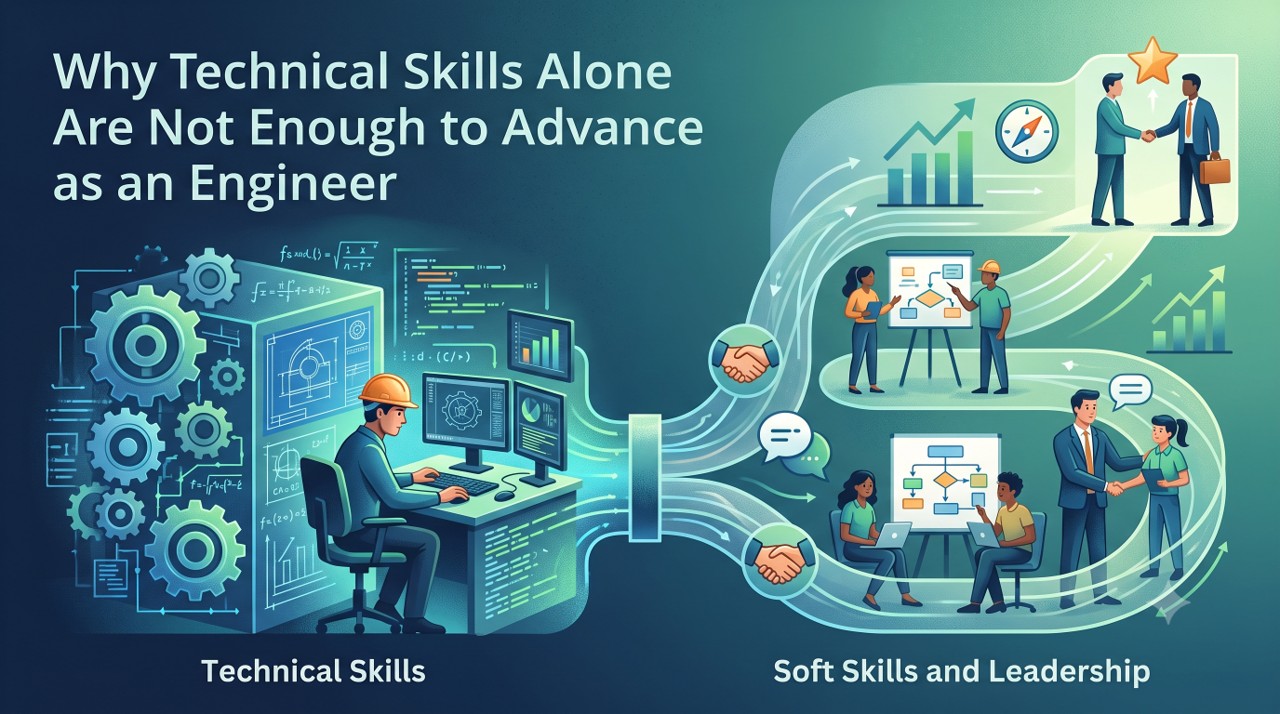
Technical skill matters in engineering.
It matters a lot.
You need to understand the fundamentals. You need to know how to perform calculations, apply codes and standards, evaluate data, use engineering software, review drawings, prepare reports, and solve real technical problems.
Early in your career, it makes sense to focus heavily on technical development. You are learning how engineering works outside the classroom. You are building judgment. You are developing confidence. You are trying to become useful on project teams.
But at some point, many young engineers realize something important.
Technical skills alone are not enough to keep advancing.
You may be technically strong and still struggle to earn more responsibility. You may be good at calculations but not trusted to lead a client conversation. You may understand the engineering answer but have difficulty explaining it clearly. You may be capable of doing the work but not yet seen as someone who can manage decisions, people, risk, or project outcomes.
That does not mean technical skill is unimportant. It means technical skill is only one part of professional growth.
To advance as an engineer, you need to develop the skills that help other people trust your judgment, communication, leadership, and reliability.
Engineering Is a People Profession Too
Many young engineers are drawn to engineering because they like solving technical problems. That is a good reason to enter the profession.
But engineering is not only about equations, drawings, models, and reports.
Engineering work is performed for people. Clients need decisions. Communities depend on safe designs. Contractors need clear direction. Regulators need complete information. Project managers need reliable updates. Senior engineers need work they can review efficiently. Younger staff need guidance.
That means your ability to work with people matters.
You do not need to be the loudest person in the room. You do not need to become a salesperson. But you do need to communicate clearly, listen carefully, explain your reasoning, and understand what other people need from you.
A technically correct answer is much more valuable when you can explain it in a way that helps someone make a good decision.
Communication Turns Technical Work into Useful Work
You can do excellent technical work, but if people cannot understand it, use it, or act on it, the value is limited.
This is one of the biggest career lessons for young engineers.
Your calculation may be correct, but can you explain the assumptions?
Your design may work, but can you describe the tradeoffs?
Your report may include the right information, but is it organized clearly?
Your recommendation may be technically sound, but does the client understand why it matters?
Good communication is not about making engineering less technical. It is about making technical information useful.
As you advance, you will be expected to write clearer emails, prepare better reports, lead meetings, explain risks, respond to questions, and communicate with people who do not have the same technical background you do.
The engineers who grow fastest are often the ones who can combine technical accuracy with clear communication.
Judgment Becomes More Important Over Time
Early in your career, you may be asked to complete specific tasks. Calculate this. Review that. Draft this section. Update this figure. Check this data. Prepare these notes.
As you gain experience, the questions become less direct.
What do you recommend?
Is this acceptable?
What are the risks?
Can we rely on this information?
Should we raise this issue with the client?
Is this design appropriate for the condition we are seeing?
These questions require judgment.
Judgment is the ability to apply technical knowledge in real-world situations. It includes understanding uncertainty, risk, cost, schedule, safety, regulations, client needs, and professional responsibility.
A technically skilled engineer may know how to perform a calculation. A more advanced engineer understands whether the calculation is appropriate, whether the assumptions are reasonable, and whether the result should be trusted.
That kind of judgment develops through experience, feedback, continuing education, field exposure, and careful attention to how decisions are made.
Reliability Builds Trust
Technical talent may get attention, but reliability builds trust.
Managers and senior engineers notice whether you do what you say you will do. They notice whether you meet deadlines, follow up on questions, communicate delays, check your work, and take responsibility for your assignments.
A brilliant engineer who is unpredictable can be difficult to manage.
A reliable engineer who communicates clearly and produces solid work becomes someone people depend on.
If you want to advance, become the person others do not have to chase. Keep track of your commitments. Respond when you say you will respond. Let people know when something changes. Finish tasks completely. Close the loop.
Reliability may not sound exciting, but it is one of the strongest foundations of career growth.
You Need to Understand Projects, Not Just Tasks
Engineering work happens inside projects.
Projects have budgets, schedules, scopes, contracts, deliverables, clients, risks, and quality requirements. If you only focus on your assigned task, you may miss the larger context.
For example, a technical detail may be important, but it may not be the decision holding up the project. A perfect analysis may not be useful if it is delivered too late. A design change may solve one issue but create a permitting problem, budget issue, or construction conflict.
Young engineers who understand project context become more valuable.
Ask questions such as:
What is the purpose of this task?
Who will use this information?
What decision does this support?
What is the deadline?
What level of detail is needed?
What are the project risks?
When you understand the project, your technical work becomes more focused and more useful.
Business Awareness Matters
Many engineers are uncomfortable with the business side of engineering, especially early in their careers.
But business awareness does not mean you stop caring about technical quality. It means you understand how professional engineering services are delivered.
Engineering firms need to manage budgets, win work, satisfy clients, control risk, meet deadlines, and maintain quality. Clients need value, responsiveness, and confidence that the engineer understands their problem.
If you understand this context, you will make better decisions.
You will understand why scope matters. You will understand why changes need to be documented. You will understand why clear communication prevents disputes. You will understand why responsiveness builds client trust. You will understand why quality problems affect both safety and business relationships.
Engineers who understand the business side are often better prepared for project management, client interaction, leadership, and ownership roles.
Ethics and Professional Responsibility Are Part of Advancement
As engineers advance, their decisions usually carry more weight.
That is especially true for licensed professional engineers. A PE license is not just a credential. It represents responsibility to protect public health, safety, and welfare.
Technical skill alone is not enough if it is not paired with ethical judgment.
You may face situations where there is pressure to move quickly, reduce cost, avoid conflict, or accept incomplete information. You may need to speak up when something does not seem right. You may need to document concerns, ask for more review, or refuse to approve work that is not ready.
These are not just technical moments. They are professional responsibility moments.
Young engineers should take ethics seriously before they are in a high-pressure situation. Understanding professional responsibility early helps prepare you for the decisions that come with greater authority.
Leadership Starts Before You Have a Leadership Title
Some young engineers think leadership begins when they become a project manager, supervisor, or principal.
That is not true.
Leadership starts earlier.
You show leadership when you take ownership of your work. You show leadership when you help a teammate. You show leadership when you raise a concern before it becomes a problem. You show leadership when you organize information clearly, prepare for meetings, follow through, and make your manager’s job easier.
You do not need a title to be someone others trust.
Over time, these habits shape your reputation. People begin to see you as steady, thoughtful, and dependable. That reputation often leads to more responsibility.
Leadership is not only about authority. It is about how you act when people are counting on you.
Continuing Education Should Support More Than License Renewal
Continuing education is often treated as a requirement for PE license renewal. That is part of it, but it should not be the only reason engineers keep learning.
Young engineers can use continuing education to build skills that support advancement.
That may include technical courses in your discipline, code updates, ethics, project management, communication, risk management, leadership, or business development. The best choices depend on your career goals and the type of work you want to do.
If you want to become more technically specialized, choose courses that deepen your expertise.
If you want to manage projects, choose courses that help you understand scope, budget, schedule, and communication.
If you want to become a stronger licensed professional, choose courses that strengthen ethics, judgment, and professional practice.
Continuing education is most valuable when it helps you become more capable, not just compliant.
The Best Engineers Combine Technical Strength with Professional Maturity
The engineers who advance are not always the ones who know the most technical details.
They are often the ones who combine technical ability with professional maturity.
They communicate clearly. They manage their responsibilities. They understand the project context. They ask good questions. They admit what they do not know. They follow through. They learn from feedback. They understand risk. They care about quality. They take ethics seriously. They help the team succeed.
That combination is powerful.
Technical skill earns respect. Professional maturity earns trust.
And trust is what leads to more responsibility.
Bottom Line
Technical skills are essential in engineering, but they are not enough by themselves.
If you want to advance as an engineer, you need to keep building technical competence while also developing communication, judgment, reliability, project awareness, business understanding, ethics, and leadership.
This does not happen all at once. It happens through daily habits, project experience, feedback, continuing education, and a willingness to keep improving.
Early in your career, focus on becoming more than the person who can complete a calculation or finish an assigned task.
Become the engineer who understands the purpose of the work.
Become the engineer who communicates clearly.
Become the engineer who follows through.
Become the engineer who can be trusted with decisions, not just assignments.
That is how technical skill turns into professional advancement.