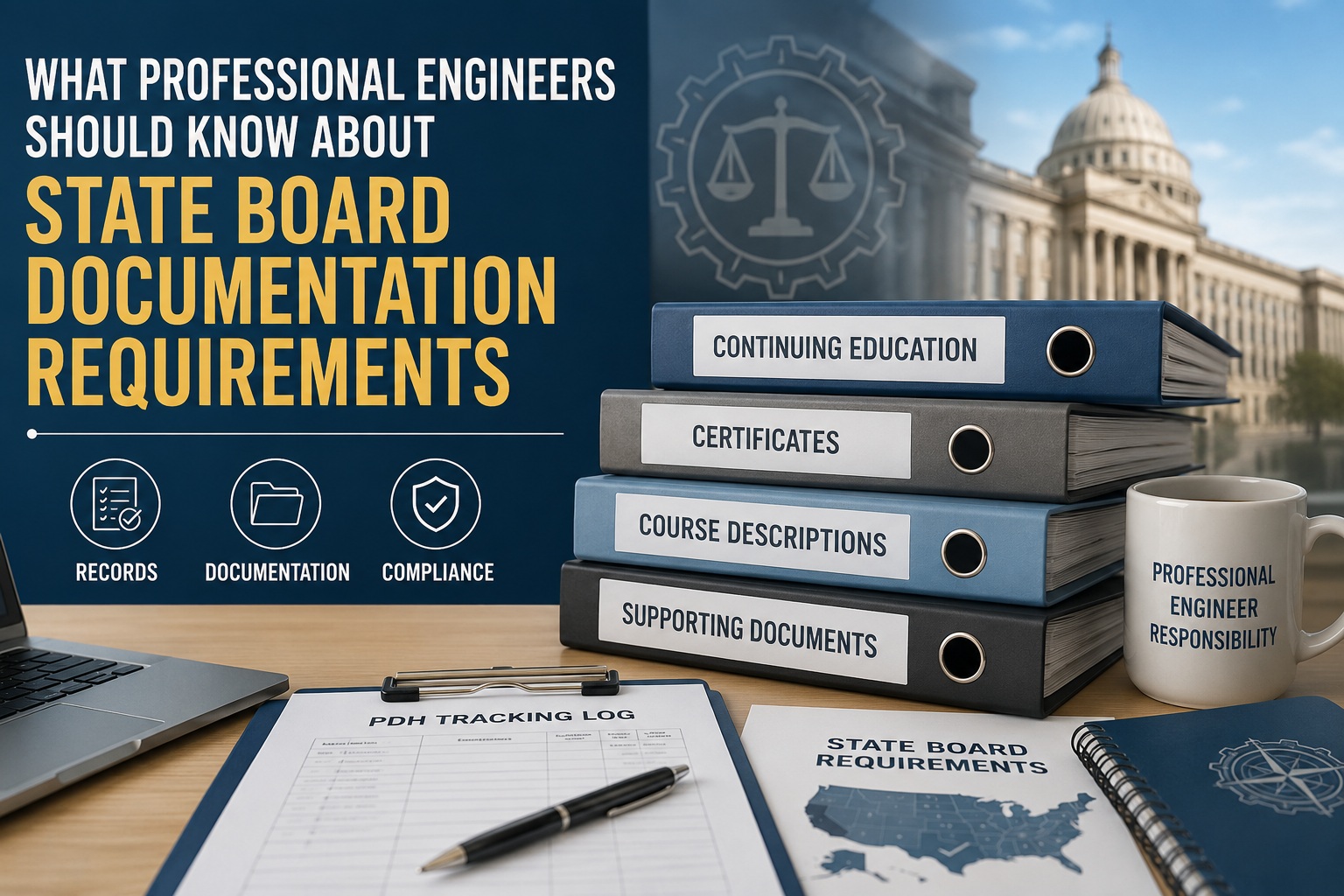
Professional engineers are responsible for meeting continuing education requirements before renewing their licenses. In most states, that means completing the required number of Professional Development Hours, or PDH, during each renewal period.
But completing the hours is only part of the responsibility.
Engineers also need to keep records that show what they completed, when they completed it, how many credits were earned, and whether the course or activity satisfied the applicable state board requirements. These records may be needed during license renewal or if the engineer is selected for a continuing education audit.
State board documentation requirements can vary, but the basic principle is the same: the engineer must be able to support the continuing education credits claimed for license renewal.
Understanding what to keep, how to organize it, and how long to retain it can help engineers avoid problems and renew with confidence.
Why Documentation Matters
Continuing education documentation is the evidence that supports a professional engineer’s license renewal.
When an engineer renews a license, the state board may ask the engineer to certify that the continuing education requirement has been met. Some boards require course details during renewal. Others allow engineers to renew based on a statement of compliance but reserve the right to request documentation later.
In either case, the engineer should be prepared to produce records if asked.
Documentation matters because it shows:
- The engineer completed the course or activity.
- The course was completed during the correct renewal period.
- The number of PDH credits claimed is reasonable.
- The subject matter was relevant to engineering practice or professional responsibility.
- Any required ethics, laws and rules, live, interactive, or state-specific requirements were satisfied.
- The engineer maintained appropriate records in support of the license renewal.
Without proper documentation, an engineer may have difficulty proving that the required continuing education was completed.
The Engineer Is Responsible for the Records
A common mistake is assuming that the course provider, employer, professional society, or webinar host will always be able to provide records later. While many providers do retain completion records, engineers should not rely entirely on outside parties.
The professional engineer is ultimately responsible for maintaining license renewal documentation.
That means the engineer should download certificates, save course descriptions when needed, record completed PDH credits, and organize records by renewal period. This is especially important for engineers who are licensed in more than one state or who complete courses from multiple providers.
Good documentation habits help prevent problems if a provider changes its website, an email is deleted, a company training record becomes difficult to access, or a course title does not clearly describe the subject matter.
What Documentation Should Engineers Keep?
The most important document is usually the certificate of completion. However, depending on the state board and the type of course, engineers may also want to keep additional information.
A good continuing education record may include:
- Certificate of completion
- Course title
- Course provider
- Completion date
- Number of PDH, CEU, CPC, or contact hours awarded
- Course description
- Learning objectives
- Course agenda or outline
- Instructor name or qualifications, if available
- Delivery format, such as online course, live webinar, in-person seminar, or self-study
- Subject category, such as ethics, technical, laws and rules, or professional practice
- Provider approval information, if applicable
- Proof of attendance, if separate from the certificate
- Payment receipt, if useful for tracking
- Renewal confirmation or reporting receipt from the state board
Not every course will require every document. For many standard PDH courses, a clear certificate of completion may be sufficient. But when a course is being used to satisfy a special requirement, additional documentation can be helpful.
For example, if a state requires engineering ethics, it may be useful to keep a course description showing that the course addressed ethics and professional responsibility. If a state requires a laws and rules course, the certificate or description should clearly identify that subject matter. If a course is delivered as a live webinar, the certificate or record should identify the format if the state distinguishes live or interactive learning from self-study.
What Should Be on a Certificate of Completion?
A certificate of completion should provide enough information to identify the course and support the credit claimed.
Ideally, a certificate should include:
- Engineer’s name
- Course title
- Course provider
- Date completed
- Number of PDH or continuing education credits awarded
- Course format
- Subject area, if applicable
- Provider name and contact information
- Authorized signature or certificate validation information, if applicable
The certificate should be saved in a format that can be easily retrieved, such as PDF. Engineers should review the certificate when they receive it to confirm that the name, course title, date, and credit amount are correct.
If there is an error, it is much easier to correct it immediately than months or years later.
Course Descriptions Can Be Important
Course titles are not always specific enough to prove that a course satisfied a particular requirement. A title may be broad, abbreviated, or unclear.
For example, a course titled “Professional Practice Update” might include ethics, laws and rules, risk management, or general project management. Without a course description, it may be difficult to show why the course was counted as ethics credit or professional practice credit.
Saving the course description can help explain what the course covered.
A useful course description may identify:
- Main topics covered
- Learning objectives
- Technical or professional practice relevance
- Applicable codes, standards, or regulations discussed
- Ethics or laws and rules content
- Intended audience
- Course length
- Method of instruction
This information may be useful if the engineer is asked to explain the course during an audit or renewal review.
Keep Records by Renewal Period
The best way to organize continuing education documentation is by renewal period.
For example, an engineer might create folders such as:
2024-2026 PE Renewal
2026-2028 PE Renewal
2028-2030 PE Renewal
Inside each folder, the engineer can save certificates and supporting documentation for that renewal cycle.
Engineers licensed in multiple states may want to create state-specific subfolders:
2024-2026 PE Renewal
Florida
New York
Wisconsin
Ohio
This is helpful because state requirements may differ. A course may satisfy a requirement in one state but not another. Separate folders make it easier to track which courses were used for each license.
Maintain a PDH Tracking Log
In addition to saving certificates, engineers should maintain a PDH tracking log.
A tracking log is a simple spreadsheet or table that summarizes completed courses and credits. It helps engineers see whether they have met the total PDH requirement and any required subject categories.
A useful PDH log may include:
| Course Title | Provider | Date Completed | PDH | Category | Format | State Applied To | Certificate Saved |
| Engineering Ethics | PDH Provider | 3/12/2026 | 2 | Ethics | Online | WI, NY | Yes |
| Stormwater Design Webinar | PDH Provider | 4/8/2026 | 2 | Technical | Live Webinar | WI, OH | Yes |
| Florida Laws and Rules | PDH Provider | 5/10/2026 | 1 | Laws and Rules | Online | FL | Yes |
The tracking log does not replace certificates, but it makes the records easier to manage. It also helps engineers identify missing credits before the renewal deadline.
Track Special Requirements Separately
Many engineers focus on the total number of PDH credits required. That is important, but it is not the only requirement in many states.
Some boards may require ethics. Others may require laws and rules. Some may limit self-study courses or require a certain number of live or interactive credits. Some may have specific provider approval or reporting requirements.
Because of this, engineers should track special requirements separately.
For example:
| Requirement | Required | Completed | Remaining |
| Total PDH | 30 | 24 | 6 |
| Ethics PDH | 2 | 2 | 0 |
| Laws and Rules | 1 | 1 | 0 |
| Live or Interactive PDH | 13 | 8 | 5 |
This helps avoid the mistake of completing enough total hours but missing a required category.
Be Careful With CEU and PDH Conversions
Some certificates use PDH. Others may use CEU, continuing education units, contact hours, or continuing education credits.
Engineers should understand how the state board defines and accepts these credits. In many continuing education settings, one PDH generally represents one contact hour of instruction, while one CEU commonly represents ten contact hours. However, engineers should always confirm how their state board handles conversions.
If a certificate lists CEU instead of PDH, the engineer should document the conversion clearly in the tracking log. For example, a course listed as 0.2 CEU may commonly represent 2 PDH, assuming the course qualifies under the applicable board rules.
Keeping clear records avoids confusion during renewal or audit review.
Documentation Requirements Vary by State
There is no single documentation rule that applies to every professional engineer in every state. Each licensing board establishes its own requirements.
State boards may differ on:
- Number of PDH required
- Renewal cycle length
- Ethics requirements
- Laws and rules requirements
- Whether course information must be reported at renewal
- Whether documentation is submitted only during an audit
- Provider approval requirements
- Accepted course formats
- Carryover credit rules
- Record retention periods
- Audit procedures
- Consequences for incomplete documentation
Because rules vary, engineers should review the requirements for each state where they hold a license.
This is especially important for engineers who maintain multiple licenses. A course that is acceptable in one state may not satisfy another state’s rules. Similarly, a record retention period in one state may not match the requirements in another.
Keep Records Long Enough
Engineers should retain continuing education records for the period required by the applicable state board. Some boards specify a minimum number of years. Others may tie the recordkeeping period to the renewal cycle or audit period.
Because retention periods vary, engineers should check the rules for each state where they are licensed. When in doubt, it is usually safer to keep records longer rather than discard them too early.
Electronic storage makes this easier. Certificates and course documents can be saved as PDFs and organized by renewal cycle. Engineers may also want to keep a backup copy in a secure cloud folder or external drive.
The goal is to make sure records are available if the board requests them later.
Employer Training May Need Extra Documentation
Some engineers earn continuing education credit through employer-provided training. This may include internal technical training, safety training, lunch-and-learn sessions, code update programs, project management training, or professional practice seminars.
Employer training can be valuable, but engineers should make sure it is properly documented if they plan to claim it for PDH credit.
A useful employer training record should include:
- Training title
- Date
- Instructor or presenter
- Length of instruction
- Agenda or outline
- Topics covered
- Attendance record
- PDH or contact hours claimed
- Explanation of relevance to engineering practice
The engineer should also confirm that the training qualifies under the applicable state board rules. Not all employer training automatically counts toward PE license renewal.
Conferences and Seminars Should Be Documented Carefully
Professional conferences, seminars, and technical meetings can provide valuable continuing education. However, documentation can be more complex because an engineer may attend only certain sessions, and not every session may qualify for engineering PDH.
For conferences, engineers should keep:
- Registration confirmation
- Agenda or program
- List of sessions attended
- Session descriptions
- Attendance certificates, if available
- PDH certificates issued by the conference provider
- Notes on which sessions were claimed for credit
Engineers should avoid claiming time for meals, breaks, exhibit hall visits, social events, or non-technical activities unless the state board specifically allows them. In most cases, only qualifying instructional time should be counted.
Live Webinars and Online Courses
Live webinars and online courses are common ways for engineers to earn PDH. Documentation should show not only the course title and credits, but also the format when that matters.
For live webinars, the certificate or attendance record should ideally show the live date and the number of credits earned. For online self-study courses, the certificate should show completion date and credit amount.
Some states treat live, interactive, timed, monitored, or self-study formats differently. Engineers should review their state rules and make sure the documentation supports the format being claimed.
For example, if an engineer needs live or interactive credits, the record should make it clear that the course was completed in that format.
Ethics and Laws and Rules Courses
Ethics and laws and rules courses deserve special attention because they are often subject-specific requirements.
If an engineer claims a course as ethics credit, the course record should clearly show that the course addressed engineering ethics, professional responsibility, public health and safety, professional conduct, conflicts of interest, or similar topics.
If an engineer claims a course as laws and rules credit, the course record should clearly show that the course addressed the relevant state’s engineering laws, board rules, statutes, regulations, or professional practice requirements.
A vague certificate may not be enough to explain why the course was counted in a special category. Saving the course description or learning objectives can help.
Carryover Credits Should Be Clearly Identified
Some states allow engineers to carry extra PDH credits into the next renewal period. Others limit carryover or do not allow it.
If carryover is allowed, engineers should document it carefully. The tracking log should identify:
- Course completed
- Original completion date
- Renewal period in which it was earned
- Number of credits carried forward
- Renewal period to which it was applied
- Any state limits on carryover
Engineers should avoid assuming that excess credits automatically carry over. Carryover rules are state-specific and may include limits on the number or type of credits that can be applied to a future period.
Multiple Licenses Require More Careful Records
Many professional engineers maintain licenses in several states. This creates additional documentation challenges.
Each state may have different rules for total PDH, ethics, laws and rules, live learning, reporting, course approval, and retention. A single course may be acceptable for several states, but not always.
Engineers with multiple licenses should maintain a tracking system that identifies which courses apply to which states.
For example:
| Course | PDH | Category | Applies To |
| Engineering Ethics | 2 | Ethics | NY, WI, PA |
| Ohio Timed Course | 3 | Timed / Technical | OH |
| Florida Laws and Rules | 1 | Laws and Rules | FL |
| Structural Design Webinar | 2 | Technical / Live | NJ, WI, OH |
This helps prevent mistakes and makes it easier to prepare renewal records for each jurisdiction.
What Happens During an Audit?
A continuing education audit is a review by a state board to confirm that an engineer completed the required continuing education for a renewal period.
If selected for an audit, the engineer may be asked to submit certificates, course details, provider information, or a completed continuing education log. The board may review whether the courses were completed within the correct renewal period, whether the credits claimed are reasonable, and whether any required subject areas were satisfied.
An audit is much easier to handle when the engineer has already organized records.
Engineers should not wait until an audit notice arrives to gather certificates. By that point, records may be difficult to find, providers may be slower to respond, and deadlines for audit response may be short.
The best audit preparation is good documentation throughout the renewal cycle.
Common Documentation Mistakes
Many documentation problems are preventable. Common mistakes include:
- Losing certificates of completion
- Saving certificates without clear file names
- Failing to track subject categories
- Assuming all courses qualify in every state
- Not saving course descriptions for ethics or laws and rules courses
- Confusing CEU and PDH values
- Claiming conference time without session documentation
- Relying only on an employer’s training system
- Waiting until renewal to organize records
- Discarding records too early
- Forgetting to document carryover credits
- Failing to separate records by state for multiple licenses
A simple recordkeeping system can help engineers avoid most of these issues.
A Practical Documentation System for Engineers
A practical system does not need to be complicated.
At the beginning of the renewal cycle, the engineer should create a folder for that cycle and a PDH tracking spreadsheet. Each time a course is completed, the engineer should save the certificate, enter the course into the tracker, and note the subject category and state where the credit will be applied.
A simple routine may look like this:
- Complete the course.
- Download the certificate.
- Save the certificate with a clear file name.
- Save the course description if needed.
- Enter the course into the PDH tracking log.
- Update the total PDH and special requirement summary.
- Back up the records.
- Review the tracker periodically before renewal.
This system takes only a few minutes per course, but it can save hours of stress later.
Bottom Line
Professional engineers should treat continuing education documentation as part of responsible license management. Completing PDH courses is important, but engineers must also be able to show what they completed and how those courses satisfy the applicable state board requirements.
The most useful records include certificates of completion, course descriptions, completion dates, credit amounts, subject categories, provider information, and a clear PDH tracking log. Engineers should organize these records by renewal period and, when applicable, by state.
Because documentation requirements vary by jurisdiction, engineers should always review the rules for each state where they are licensed. A course may satisfy one state’s requirements but not another’s, and record retention periods may differ.
Good documentation helps engineers renew with confidence, respond to audits efficiently, and demonstrate that they take their professional obligations seriously.
For professional engineers, continuing education is not just about earning credits. It is about maintaining competence, protecting the public, and upholding the standards of the engineering profession. Proper documentation is the record that supports that commitment.