
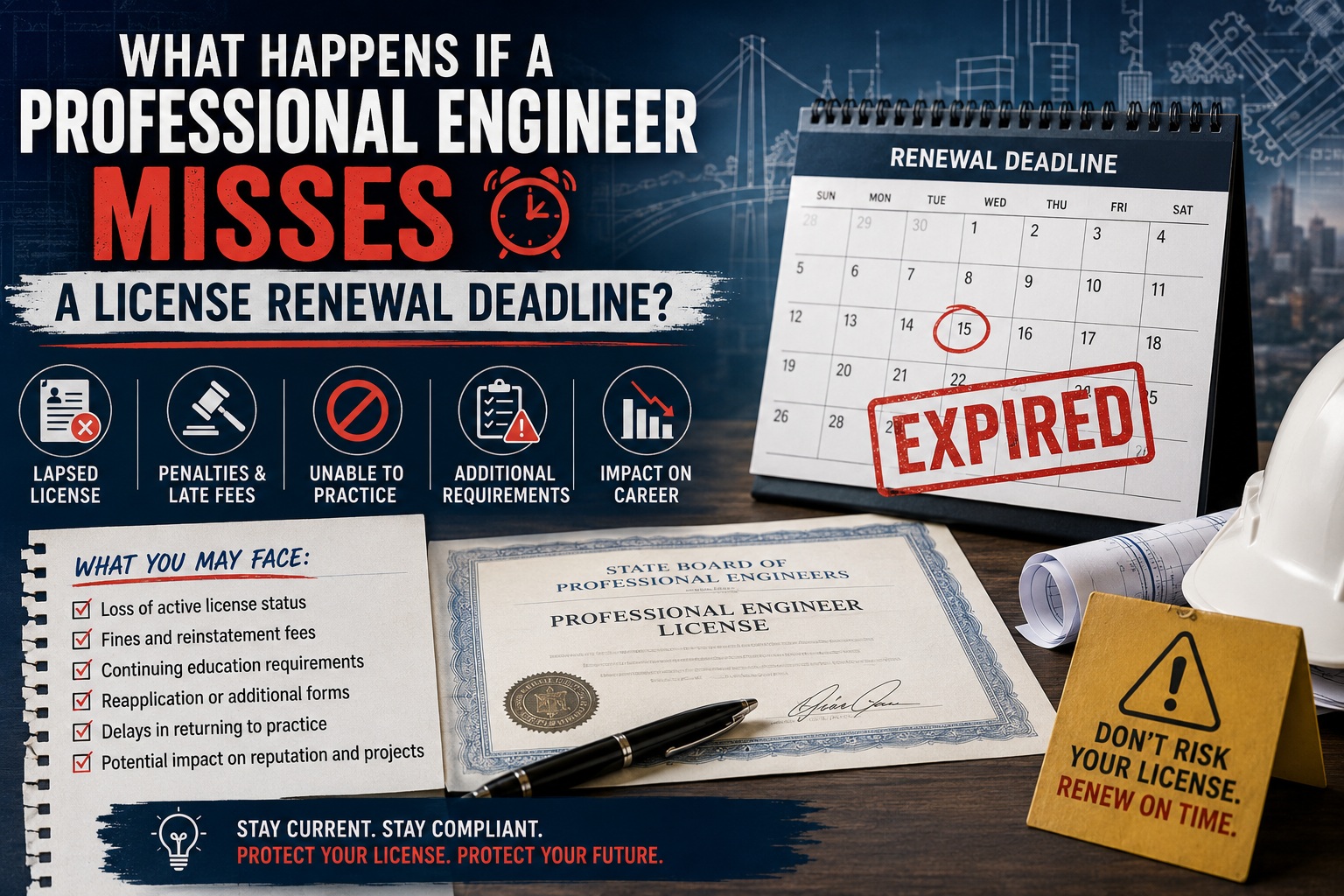
Missing a professional engineer license renewal deadline can create serious problems. A PE license is not just a credential on a resume. It is the legal authority to offer or provide engineering services to the public, sign and seal engineering documents, and represent oneself as a licensed professional engineer.
When a renewal deadline is missed, the consequences depend on the state licensing board. In some cases, the license may become delinquent, expired, inactive, lapsed, suspended, or otherwise no longer in good standing. The exact terminology varies by jurisdiction, but the practical issue is the same: the engineer may no longer have an active license.
For professional engineers, that can affect current projects, employer responsibilities, client commitments, firm licensing, contract obligations, and the ability to practice engineering legally.
The most important step is to address the missed renewal quickly and carefully. Engineers should review the state board’s instructions, stop any activities that require an active license if the license is no longer valid, complete any missing continuing education, pay required fees, and follow the board’s reinstatement or late renewal process.
Renewal Deadlines Matter
Professional engineering licenses must be renewed according to the schedule established by the state licensing board. Renewal usually requires some combination of:
- Completing required continuing education
- Certifying compliance with professional development requirements
- Reporting PDH or continuing education hours, if required
- Paying the renewal fee
- Updating contact information
- Confirming license status
- Completing any state-specific renewal steps
If an engineer misses the deadline, the board may treat the license as expired or delinquent. Depending on the state, there may be a grace period, late fee, reinstatement process, or additional requirement to return the license to active status.
Engineers should not assume that missing a deadline is a minor administrative issue. In some states, a missed deadline can quickly affect the engineer’s ability to practice.
The License May No Longer Be Active
The first concern after a missed renewal deadline is license status.
A professional engineer should confirm whether the license is still active, expired, delinquent, inactive, suspended, or otherwise restricted. State boards use different terms, and those terms matter.
If the license is no longer active, the engineer may not be authorized to practice engineering, offer engineering services, sign and seal documents, or use the PE title in the same way as an active licensee.
This can create problems for engineers who are currently serving as engineer of record, responsible charge, project manager, technical reviewer, firm qualifier, or licensed professional on active projects.
The engineer should check the state board’s online license lookup system and review any renewal notices or correspondence from the board. If the status is unclear, the engineer should contact the board directly.
Practicing With an Expired License Can Be a Serious Problem
Practicing engineering without an active license can create legal and professional consequences.
The exact rules vary by state, but engineers generally should not provide services that require a PE license if their license has expired or lapsed. This may include signing and sealing engineering documents, submitting engineering work to public agencies, offering engineering services to the public, or representing oneself as an active licensed professional engineer.
This issue is especially important for engineers in consulting, public works, construction, design, environmental compliance, structural engineering, civil site design, mechanical systems, electrical systems, and other regulated practice areas.
If a license has expired, the engineer should avoid assuming that late renewal automatically solves work performed during the lapse. The board may have specific rules about the lapse period, late fees, continuing education, reinstatement, and whether any practice during the lapse creates a violation.
When in doubt, the safest approach is to stop activities that require an active license until the board confirms the license is active again.
Late Renewal May Be Possible
In many states, an engineer who misses a renewal deadline may be able to renew late by completing the required steps. This may include paying a renewal fee, paying a late fee, completing missing continuing education, and submitting required forms.
However, late renewal rules are state-specific.
Some boards allow late renewal for a limited period. Others may require a reinstatement application if the license has been expired beyond a certain amount of time. Some may require additional documentation, proof of continuing education, explanation of practice during the lapse, or board review.
Engineers should not rely on general assumptions. They should use the process provided by the licensing board for the state where the license was issued.
Reinstatement May Be Required
If a license has been expired for too long, simple late renewal may no longer be available. The engineer may need to apply for reinstatement.
Reinstatement is usually more involved than renewal. Depending on the state and the length of the lapse, reinstatement may require:
- A reinstatement application
- Payment of renewal and reinstatement fees
- Completion of missing continuing education
- Proof of prior licensure
- Explanation of engineering work performed during the lapse
- Updated experience information
- References or endorsements
- Board review
- Additional state-specific requirements
In some situations, a long-expired license may be harder to restore. The board may require additional documentation or may treat the applicant differently from someone who renewed shortly after the deadline.
The longer an engineer waits, the more complicated the process can become.
Continuing Education May Still Be Required
A missed renewal deadline does not necessarily eliminate the continuing education requirement.
In many cases, the engineer must still complete the required PDH, ethics, laws and rules, live webinar, interactive learning, or other continuing education before the license can be renewed or reinstated.
This is one reason engineers should keep PDH records organized throughout the renewal period. If the renewal deadline is missed, the engineer may need to quickly determine:
- How many PDH credits were completed
- Whether the credits were completed during the correct renewal period
- Whether ethics requirements were satisfied
- Whether state-specific laws and rules requirements were satisfied
- Whether course format requirements were met
- Whether certificates are available
- Whether additional courses must be completed before renewal or reinstatement
If the engineer is missing required credits, those should be completed as soon as possible using courses that meet the state board’s rules.
Documentation Becomes More Important
When a renewal deadline is missed, documentation becomes especially important.
The engineer may need to show that continuing education was completed, that required subject areas were satisfied, and that any late renewal or reinstatement application is supported by proper records.
Useful documentation may include:
- Certificates of completion
- Course descriptions
- PDH tracking logs
- Ethics course certificates
- Laws and rules course certificates
- Live webinar or attendance records
- Renewal notices
- Board correspondence
- Proof of payment
- Confirmation of submitted renewal or reinstatement forms
Engineers should save all records related to the missed deadline and the corrective steps taken. If questions arise later, clear documentation will be much easier to explain than incomplete records.
Multiple Licenses Can Complicate the Issue
Many professional engineers hold licenses in more than one state. Missing a renewal deadline in one jurisdiction may create complications for other licenses.
For example, an engineer applying for comity licensure or renewing another state license may be asked whether any license has lapsed, expired, been disciplined, or fallen out of good standing. Some applications ask about prior disciplinary actions, practice history, or license status in other states.
A missed renewal may also affect a firm’s ability to provide engineering services in a state if that license was tied to responsible charge, firm registration, or a certificate of authorization.
Engineers with multiple licenses should review each state separately and keep accurate records of license status, renewal dates, and reinstatement actions.
Firm Licensing and Responsible Charge Issues
A missed individual PE renewal may also affect an engineering firm.
In many states, engineering firms must maintain firm licensure, registration, or a certificate of authorization. These firm credentials may depend on having one or more licensed professional engineers in responsible charge.
If a key engineer’s license expires, the firm may need to evaluate whether it still satisfies the state’s requirements to offer engineering services. This is especially important for small firms, sole practitioners, branch offices, and firms where one PE serves as the primary qualifying professional.
The engineer and firm should review whether the expired license affects:
- Responsible charge
- Firm registration
- Certificate of authorization
- Sealing authority
- Project submittals
- Contracts
- Public agency submissions
- Client representations
- Insurance or risk management obligations
If firm authorization may be affected, the issue should be addressed promptly.
What Engineers Should Do Immediately After Missing a Deadline
An engineer who misses a renewal deadline should act quickly and deliberately.
The first step is to check the license status on the state board website. The engineer should determine whether the license is still active, expired, delinquent, inactive, or otherwise restricted.
Next, the engineer should review the board’s late renewal or reinstatement instructions. This may include checking renewal forms, continuing education reporting requirements, fees, deadlines, and any special instructions for expired licenses.
The engineer should then gather continuing education records. If required PDH credits are missing, the engineer should complete acceptable courses as soon as possible.
If the license is no longer active, the engineer should avoid practicing or offering engineering services in that jurisdiction until the license is properly renewed or reinstated.
Finally, the engineer should keep records of every corrective step, including course completions, application submissions, payments, and board correspondence.
A Practical Recovery Checklist
If you missed a PE license renewal deadline, use the following checklist:
- Check your current license status through the state board.
- Confirm whether the license is active, expired, delinquent, inactive, or lapsed.
- Review the board’s late renewal or reinstatement process.
- Stop any work that requires an active PE license if your license is no longer active.
- Gather all continuing education certificates and PDH records.
- Confirm whether ethics, laws and rules, live, or state-specific requirements are complete.
- Complete any missing continuing education.
- Pay required renewal, late, or reinstatement fees.
- Submit required renewal or reinstatement forms.
- Save confirmation of submission and payment.
- Wait for confirmation that the license is active before resuming licensed practice.
- Update your PDH tracking and calendar system to prevent future missed deadlines.
This checklist does not replace state board instructions, but it provides a practical starting point.
Do Not Ignore Board Notices
If the licensing board sends a notice about an expired license, late renewal, audit, deficiency, or reinstatement requirement, the engineer should respond promptly.
Ignoring board correspondence can make the situation worse. A missed deadline may be manageable if addressed quickly, but failure to respond can lead to additional complications.
Engineers should keep their mailing address, email address, and contact information current with each state board. Renewal reminders and board notices are often sent to the contact information on file. If the engineer misses those notices because the address is outdated, the responsibility may still remain with the licensee.
How to Prevent a Missed Renewal in the Future
The best way to handle a missed renewal deadline is to prevent it from happening again.
Professional engineers should maintain a simple license management system. This can be done with a spreadsheet, calendar reminders, email folders, and organized PDH records.
A useful system should track:
- State licenses held
- License numbers
- Renewal deadlines
- Renewal cycle dates
- Total PDH required
- Ethics requirements
- Laws and rules requirements
- Course format requirements
- PDH completed
- Certificates saved
- Renewal fee payment status
- Renewal submission confirmation
Engineers should set multiple calendar reminders before each renewal deadline. For example, reminders at six months, three months, one month, and two weeks before renewal can help prevent last-minute issues.
Engineers should also complete required ethics or state-specific courses early in the renewal period rather than waiting until the deadline.
Special Considerations for Inactive or Retired Status
Some engineers intentionally move a license to inactive or retired status when they are not practicing engineering in a particular state. This is different from simply missing a renewal deadline.
Inactive or retired status usually has specific rules. An engineer may not be allowed to practice under that license while inactive or retired. Returning to active status may require an application, fees, continuing education, or other board requirements.
Engineers who no longer need an active license should review the state board’s inactive or retired status options before letting the license lapse. Choosing the correct status may be better than missing a deadline and dealing with an expired license later.
Common Mistakes After Missing a Renewal Deadline
Engineers should avoid these common mistakes:
- Assuming the license is still active without checking
- Continuing to sign and seal documents after expiration
- Assuming late payment automatically restores the license
- Ignoring missing continuing education requirements
- Failing to document corrective actions
- Waiting too long to begin reinstatement
- Assuming rules are the same in every state
- Forgetting that firm licensing may also be affected
- Relying only on verbal advice without board confirmation
- Discarding renewal notices or board emails
- Failing to update contact information with the board
A missed renewal deadline is usually easier to correct when addressed early. Delay creates risk.
Bottom Line
If a professional engineer misses a license renewal deadline, the consequences depend on the rules of the state licensing board. The license may become delinquent, expired, inactive, lapsed, or otherwise no longer active. The engineer may need to pay late fees, complete missing continuing education, submit a reinstatement application, or satisfy other board requirements.
The most important point is that an engineer should not continue practicing, offering engineering services, or signing and sealing documents if the license is no longer active.
Engineers who miss a deadline should check their license status immediately, review the board’s instructions, gather continuing education documentation, complete any missing requirements, and follow the official renewal or reinstatement process.
For professional engineers, license renewal is part of responsible professional practice. A simple tracking system, organized PDH records, and early reminders can help prevent missed deadlines and protect the engineer’s ability to practice.