Technical ability is the foundation of engineering practice. Engineers need discipline-specific knowledge, analytical skills, design judgment, and an understanding of codes, standards, materials, systems, and methods that apply to their area of work.
A structural engineer needs structural knowledge. A civil engineer needs civil engineering knowledge. A mechanical engineer needs mechanical systems knowledge. An environmental engineer needs environmental and regulatory knowledge. An electrical engineer needs electrical design and systems knowledge.
Technical competence matters.
But the engineers who grow into stronger project leaders, trusted advisors, reviewers, managers, and mentors usually develop skills beyond their narrow technical specialty. They learn how to communicate clearly, manage risk, understand related disciplines, document decisions, lead teams, and apply professional judgment in complicated situations.
These skills do not replace technical knowledge. They make technical knowledge more useful.
Engineering projects are rarely simple. They involve clients, regulators, contractors, budgets, schedules, public safety, technical uncertainty, documentation, and coordination across multiple disciplines. Engineers who can work effectively in that environment become more valuable.
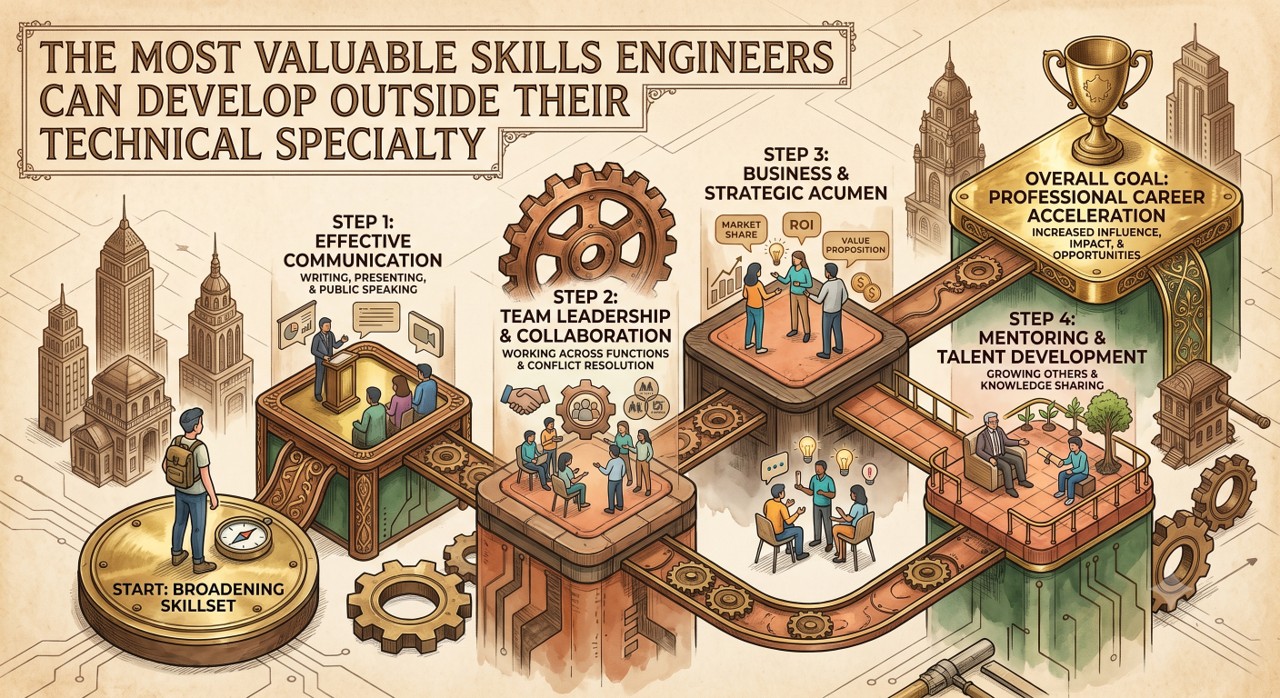
Here are some of the most valuable skills engineers can develop outside their technical specialty.
Communication
Communication may be the most important nontechnical skill an engineer can develop.
Engineers do not just solve problems. They explain problems, document assumptions, present recommendations, respond to questions, write reports, prepare proposals, coordinate with teams, and communicate risks.
An engineer may have the right technical answer, but if that answer is not communicated clearly, it may not be understood or used properly.
Strong engineering communication includes:
- Writing clear emails and reports
- Explaining technical issues to nontechnical audiences
- Presenting options and recommendations
- Documenting assumptions and limitations
- Asking better questions
- Listening carefully to clients, contractors, regulators, and colleagues
- Communicating uncertainty without creating confusion
Good communication helps prevent misunderstandings. It also helps engineers build trust.
Clients and project teams do not only value engineers who know the answer. They value engineers who can explain what the answer means, why it matters, and what should happen next.
Technical Writing and Documentation
Technical writing deserves special attention because it is central to engineering practice.
Engineering work often becomes part of the project record. Reports, calculations, drawings, specifications, field notes, design memoranda, meeting minutes, inspection forms, permit applications, and emails may all be reviewed later.
Clear documentation helps show what was known, what assumptions were made, what decisions were reached, and why a recommendation was reasonable.
Poor documentation can create problems even when the engineering work itself was sound.
Engineers should develop the ability to write in a way that is clear, organized, accurate, and defensible. That means avoiding vague language, documenting limitations, explaining the basis for conclusions, and making sure the reader can follow the reasoning.
A technically correct recommendation is more valuable when it is supported by clear documentation.
Project Management
Not every engineer wants to become a full-time project manager, but nearly every engineer benefits from understanding project management.
Engineering work is performed within real project constraints. There are schedules, budgets, scopes of work, deliverables, reviews, approvals, client expectations, and competing priorities.
Engineers who understand project management are better able to plan their work, anticipate problems, communicate delays, manage resources, and keep tasks moving.
Important project management skills include:
- Understanding scope
- Managing deadlines
- Tracking budgets
- Coordinating deliverables
- Identifying risks early
- Communicating with clients
- Managing changes
- Following up on action items
- Keeping records organized
These skills become more important as engineers advance. A young engineer may be responsible for a task. A mid-career engineer may be responsible for a project. A senior engineer may be responsible for teams, clients, risk, and quality.
Learning project management early can make that transition much easier.
Risk Awareness
Engineering decisions involve risk. Some risks are technical. Others involve safety, cost, schedule, compliance, operations, construction, public perception, or professional responsibility.
Risk awareness is the ability to recognize what could go wrong and understand how a decision might affect the project, the public, the client, or the engineer’s professional obligations.
This does not mean engineers should be overly cautious or avoid making decisions. Engineering always involves judgment. But competent engineers should understand the consequences of uncertainty, incomplete information, assumptions, and limitations.
Risk awareness helps engineers ask questions such as:
- What assumptions are most important?
- What information is missing?
- What happens if conditions are different than expected?
- Is this issue safety-critical?
- Does this require additional review?
- Has the client been informed of important limitations?
- Is this decision properly documented?
- Should another specialist be involved?
Engineers who understand risk are better prepared to make responsible decisions.
Ethics and Professional Judgment
Ethics is not separate from engineering practice. It is part of engineering practice.
Engineers may face pressure from clients, employers, budgets, schedules, or project politics. They may need to decide whether they are qualified to perform certain work, whether a safety concern needs to be elevated, whether limitations have been disclosed clearly, or whether a document should be signed and sealed.
These situations require professional judgment.
Ethics and professional responsibility courses can help engineers think through real-world situations before they happen. They reinforce the importance of honesty, competence, public safety, transparency, and accountability.
Technical ability is essential, but technical ability without professional judgment is not enough.
A strong engineer understands not only how to solve a problem, but also when to ask questions, when to document concerns, when to involve others, and when public health, safety, and welfare must come first.
Understanding Adjacent Disciplines
Engineering projects are often multidisciplinary.
A civil engineer may need to understand enough about environmental permitting, geotechnical concerns, utility coordination, or construction sequencing to ask better questions. A mechanical engineer may need to understand electrical coordination, controls, energy codes, or building operations. A structural engineer may benefit from understanding geotechnical limitations, building envelope issues, or construction inspection. An environmental engineer may benefit from understanding construction methods, process equipment, hydrogeology, or operations and maintenance.
The goal is not to practice outside your area of competence. The goal is to understand how your work connects with the work of others.
Engineers who understand adjacent disciplines can identify conflicts earlier, communicate more effectively, and recognize when specialized expertise is needed.
This makes them more valuable on project teams.
A good engineer knows their specialty. A stronger project engineer understands how that specialty fits into the larger project.
Client and Stakeholder Communication
Engineers often work with people who do not share the same technical background. Clients, owners, regulators, contractors, public officials, facility managers, and community members may all need to understand engineering recommendations.
The ability to communicate with stakeholders is different from communicating with other engineers.
It requires clarity, patience, and judgment. Engineers must explain technical issues without oversimplifying them. They must be honest about uncertainty without sounding indecisive. They must explain risk without creating unnecessary alarm. They must help people make informed decisions.
This skill becomes increasingly important as engineers move into project management, consulting, leadership, or client-facing roles.
A technically strong engineer who can also communicate effectively with stakeholders has a major career advantage.
Quality Control
Quality control is another skill that extends beyond a single technical specialty.
Engineering work needs to be checked, reviewed, verified, and documented. Mistakes can occur in calculations, drawings, assumptions, data entry, units, references, specifications, and communications.
Engineers who understand quality control are more careful in their own work and more effective when reviewing the work of others.
Good quality control habits include:
- Checking units
- Reviewing assumptions
- Verifying inputs
- Confirming references
- Comparing results to expected ranges
- Reviewing calculations and drawings for consistency
- Checking that conclusions follow from the data
- Documenting review comments
- Resolving comments clearly
Quality control is not just a senior engineer’s responsibility. Younger engineers who build strong QC habits early become more reliable and easier to trust with greater responsibility.
Leadership and Mentoring
Leadership in engineering is not limited to job titles.
An engineer can show leadership by helping a teammate, organizing information, raising a concern, sharing a lesson learned, improving a process, or mentoring someone with less experience.
As engineers advance, leadership becomes more important. Technical work increasingly involves guiding others, reviewing work, managing expectations, making decisions, and helping teams perform well.
Leadership skills include:
- Giving clear direction
- Providing useful feedback
- Supporting younger engineers
- Taking responsibility for decisions
- Managing conflict professionally
- Encouraging quality and accountability
- Communicating priorities
- Creating a culture of learning
Mentoring is also a valuable professional skill. Engineers who can explain concepts, review work constructively, and help others grow strengthen both the team and the profession.
Business and Financial Awareness
Engineering decisions often have financial consequences.
Even engineers who do not work directly in business development or management benefit from understanding budgets, proposals, billing, project profitability, change orders, and client value.
Business awareness helps engineers understand why scope matters, why communication matters, and why managing time is important.
This does not mean compromising technical quality. It means understanding the business context in which engineering services are delivered.
Engineers who understand both technical work and business realities are often better prepared for project management, leadership, consulting, and ownership roles.
They can help deliver good engineering while also supporting a successful project.
Regulatory and Compliance Awareness
Many engineering projects are affected by permits, regulations, codes, board rules, safety requirements, environmental requirements, and documentation standards.
Regulatory awareness helps engineers understand the framework around their technical work.
For some engineers, this may involve environmental regulations, stormwater permits, building codes, energy codes, occupational safety requirements, hazardous materials rules, air permitting, wastewater regulations, or professional licensing laws.
Engineers do not need to become attorneys. But they should understand which requirements affect their work and when specialized legal or regulatory guidance may be needed.
Regulatory awareness helps engineers avoid preventable problems and make better recommendations.
Adaptability
Engineering is a changing profession.
New technologies emerge. Software changes. Regulations are updated. Clients develop new expectations. Project delivery methods evolve. Workflows become more digital. Artificial intelligence, automation, data analytics, sustainability, electrification, resilience, and cybersecurity are changing many areas of engineering practice.
Engineers who are adaptable are better prepared for change.
Adaptability does not mean chasing every trend. It means being willing to learn, question assumptions, update methods, and remain open to better ways of working.
Continuing education can support adaptability by giving engineers structured opportunities to explore new topics, refresh fundamentals, and stay aware of changes that may affect their practice.
The engineers who continue learning are often better positioned for long-term career growth.
How Engineers Can Build These Skills
Developing skills outside a technical specialty does not require a dramatic career change. Engineers can build these skills gradually.
Practical steps include:
- Choose continuing education courses outside your narrow specialty
- Volunteer to present a project update
- Ask to help with proposals or client meetings
- Review project budgets or schedules
- Take a course on technical writing or communication
- Learn the basics of a related discipline
- Ask senior engineers how they evaluate risk
- Participate in quality control reviews
- Mentor a younger engineer or intern
- Write down lessons learned after projects
- Share useful takeaways from courses or webinars
Small steps add up over time.
An engineer who improves communication, documentation, risk awareness, and project coordination becomes more valuable even without changing technical discipline.
Choosing Continuing Education That Builds Broader Skills
Continuing education is one of the easiest ways to build skills outside a technical specialty.
Engineers can use required PDH credits strategically by selecting courses that support both license renewal and career development.
A balanced continuing education plan may include:
- Technical courses in the engineer’s primary discipline
- Ethics and professional responsibility courses
- Project management courses
- Risk management or quality control courses
- Communication and documentation courses
- Courses on codes, standards, or regulations
- Courses on adjacent disciplines
- Courses on emerging technologies
The best course mix depends on the engineer’s current role and future goals.
A younger engineer may benefit from technical writing, fundamentals refreshers, ethics, and project coordination. A mid-career engineer may benefit from project management, client communication, technical review, and risk management. A senior engineer may benefit from leadership, mentoring, quality systems, professional responsibility, and emerging issues.
Continuing education should not be treated only as a license renewal requirement. It can be used as a practical tool for career growth.
Final Thoughts
Technical knowledge is essential in engineering. Engineers must understand their discipline and practice within the limits of their competence.
But the most valuable engineers usually develop skills beyond their technical specialty.
They communicate clearly. They document decisions well. They understand project management, risk, ethics, quality control, and related disciplines. They know how to work with clients, regulators, contractors, and project teams. They continue learning as their responsibilities grow.
These skills make engineers more effective, more trusted, and more prepared for leadership.
An engineer’s technical specialty may define the starting point of a career. But broader professional skills often determine how far that career can go.
For engineers who want to grow, the question is not only, “How can I become better technically?”
It is also:
“What skills outside my specialty would make me more useful, more trusted, and more effective as an engineer?”