
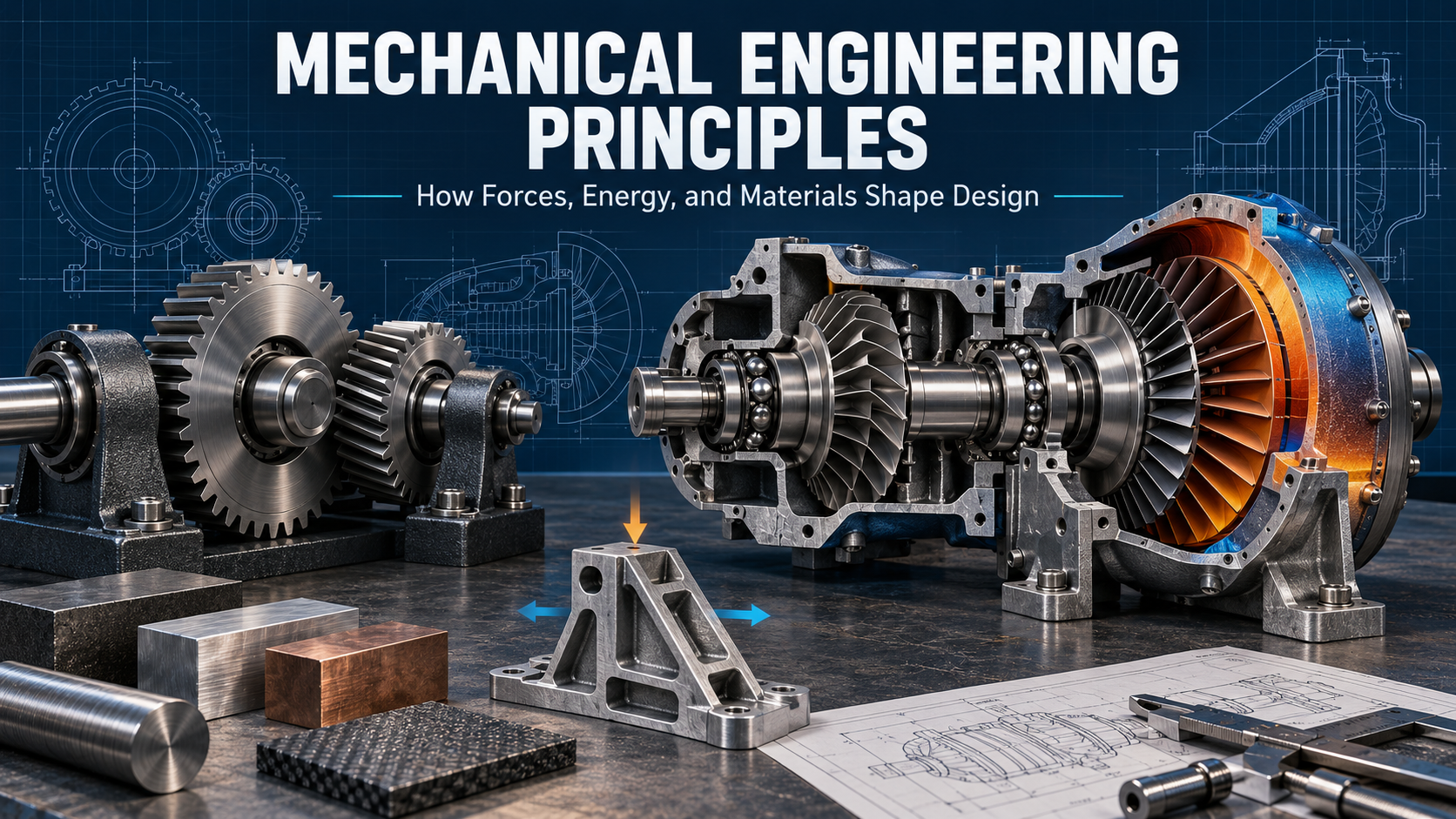
Why does a bracket bend when it can carry the load without breaking? Why does a larger pump sometimes create more trouble than it solves? And why can a machine run smoothly at one speed but vibrate badly at another?
Mechanical engineering principles explain how forces, energy, fluids, and materials interact. They help you predict whether equipment will move, carry loads, transfer heat, and perform reliably under actual operating conditions.
You do not need to memorize every equation to use them well. Start by understanding what each relationship describes, which assumptions it requires, and when those assumptions stop matching reality.
A calculation becomes useful when it answers a physical question. What carries the load? Where does the energy go? What could fail first?
Applying Engineering Principles helps you balance forces, energy, material choices, and cost while keeping mechanical designs safe and practical to maintain.
Core Principles: Forces, Energy, and Flow
The core mechanical engineering topics connect through a few physical laws. Conservation of mass tracks material. Conservation of energy tracks transfers and storage. Newton’s laws connect forces with acceleration.
Forces, Torque, and Equilibrium
Engineering mechanics begins with identifying the object you want to study and the forces acting on it. Draw a free-body diagram before opening a spreadsheet. Include weight, applied loads, friction, and reactions at connections.
For a body in static equilibrium, the sums of external forces and moments equal zero. A moment describes a force’s turning effect about a point or axis.
Consider a horizontal bracket carrying a 200-newton downward load 0.30 meters from its wall connection. Ignoring the bracket’s weight, that load creates a 60-newton-meter moment at the wall.
Shortening the projection to 0.15 meters halves the moment without changing the load. Geometry can matter as much as material choice.
When an object accelerates, the net force equals mass times acceleration: F = ma for constant mass. A lifting mechanism must therefore account for acceleration as well as the suspended weight. A steady lift and a sudden start create different demands.
Electrical Engineering Principles help you account for motors, sensors, controls, and power requirements when designing mechanical equipment.
Energy, Work, and Power
Work transfers energy through a force acting over a displacement. Power measures how quickly that transfer occurs. A motor may have enough torque to turn a shaft yet lack the power to maintain that torque at the required speed.
For rotation, shaft power equals torque multiplied by angular velocity, using consistent units.
Thermodynamics extends the energy balance to heat and internal energy. For a closed system with negligible changes in overall kinetic and potential energy, ΔU = Q − W, where Q is heat entering and W is work leaving. The OpenStax explanation of the first law details this sign convention.
The second law adds a restriction: a cyclic heat engine cannot convert all heat from a single reservoir into useful work. Energy conservation alone does not establish that a proposed machine can operate.
Heat transfer addresses the rate of thermal exchange through conduction, convection, and radiation. A motor enclosure might release heat too slowly even when its energy balance contains no arithmetic error. Geotechnical Engineering Principles matter when heavy machinery, tanks, or piping systems rely on foundations that must limit settlement and support operating loads.
Fluid Flow and Pressure Loss
Fluid dynamics connects velocity, pressure, density, and the forces that affect moving liquids or gases.
For steady, incompressible flow through a pipe without branches or leaks, volumetric flow equals cross-sectional area multiplied by average velocity: Q = Av. Here Q means volumetric flow, not the heat quantity used above. The OpenStax continuity discussion explains this relationship.
Reducing a pipe’s internal diameter by half reduces its area to one-quarter. At the same flow rate, average velocity becomes four times greater.
That condition also changes friction losses. Do not assume a pump will maintain the original flow after you install smaller piping. The actual operating point depends on both the pump curve and the system’s pressure requirements.
Materials Science: Strength, Stiffness, and Service Life
A component can resist permanent deformation and still flex too much to function. It can also survive one heavy load but crack after many smaller load cycles.
Material selection needs more than a high strength value.
Distinguish Strength from Stiffness
Strength concerns a material’s resistance to yielding or failure. Stiffness concerns resistance to elastic deformation. Young’s modulus describes a material’s tensile or compressive stiffness within its linear elastic range, while component stiffness also depends on geometry.
For a uniform member under centered axial loading, nominal normal stress equals force divided by cross-sectional area: σ = F/A. Holes, notches, bending, and other conditions can create stresses that this simple expression does not capture.
The OpenStax guide to stress and strain explains the relationship between loading, deformation, and elastic modulus.
Imagine a machine cover that bends enough to rub against a moving part. Substituting a stronger grade of steel may do little for deflection because many steel grades have similar elastic moduli. A rib, folded edge, or shorter unsupported span may address the actual issue more effectively.
Check Fatigue, Buckling, and Temperature
Repeated loading can initiate and grow fatigue cracks, sometimes at stresses below the material’s yield strength. A rotating shaft therefore needs more than a one-time overload check.
Slender members under compression can buckle before reaching their compressive yield strength. Connection conditions and unsupported length matter.
Temperature also changes behavior. Thermal expansion can close a clearance that looked generous during cold assembly, while prolonged high-temperature loading can cause creep in susceptible materials.
Include corrosion, wear, and the surrounding environment when estimating service life. The best material on a room-temperature data sheet may perform poorly in the actual application.
Apply Mechanical Engineering to Everyday Equipment
These ideas become useful when you combine them. A pump skid, conveyor, or ventilation fan rarely presents only one kind of problem.
Use this sequence when evaluating mechanical systems:
- Define the duty. Establish loads, speed, temperature, operating duration, and acceptable performance.
- Identify credible failure modes. Consider deformation, fatigue, overheating, leakage, instability, and unsafe access.
- Build a simple model. State boundaries, assumptions, units, and the properties you need.
- Check the result. Compare it with an independent estimate, supplier information, or a representative test.
- Examine installation and maintenance. Confirm clearances, alignment, access, and replacement procedures.
These design principles keep the calculation connected to the equipment people will actually use.
Example: A Pump Skid with Persistent Vibration
Suppose a new pump meets its flow target but shakes the frame at certain speeds.
Start with observations. Does the vibration follow rotational speed? Does it change with flow? Check alignment, fastening, and operating conditions before assuming the motor causes the problem.
The frame’s stiffness and mass influence its natural frequencies. If an excitation frequency approaches a natural frequency, resonance can amplify vibration; damping affects the response.
Simply adding weight may shift the troublesome frequency into another operating range. Adding stiffness may help, but you should evaluate the resulting frequency change rather than guess.
Also investigate hydraulic causes, including cavitation, when symptoms support them. Similar-looking vibration can have different sources. Measure the behavior before selecting a remedy.
Use Models Without Trusting Them Blindly
Finite element analysis can estimate stress and deflection, but its result depends on loads, restraints, contact assumptions, material properties, and mesh quality.
A model that fixes an entire mounting surface rigidly may predict less movement than flexible real-world connections allow.
Use hand calculations to check scale and direction. Then compare predictions with measurements when practical. A polished contour plot does not validate its own assumptions.
FAQs and Learning Resources
What Are the First Principles in This Field?
They include Newton’s laws and conservation of mass, energy, and momentum. Constitutive relationships, such as an elastic stress-strain law, connect those balances to material behavior. Start with these foundations when an unfamiliar problem makes a memorized formula feel unreliable.
What Is the 80/20 Rule?
The Pareto idea suggests that a relatively small share of causes may explain a large share of observed effects. You might use failure records to prioritize recurring maintenance issues. The ratio is a heuristic, not a physical law. Never use it to dismiss a rare event with severe safety consequences.
What Are Five Important Skills for a Mechanical Engineer?
A useful grouping includes physical reasoning, mathematical modeling, technical drawing and CAD, testing and troubleshooting, and communication. This is a practical list rather than an official ranking. The BLS occupational profile describes duties and typical educational preparation, including a bachelor’s degree in the field or a related discipline.
Where Should Beginners Start Learning?
Begin with algebra, trigonometry, calculus, and introductory physics. Add statics, dynamics, thermodynamics, and material behavior as your foundation develops. First-year subjects vary by university, so check the actual curriculum.
Use a reputable textbook or an openly licensed text such as OpenStax. If you prefer PDF notes, keep the assumptions and units beside each equation. A formula sheet without those details encourages mistakes.
Make your training practical: sketch a bracket, estimate a heating load, or calculate a shaft’s torque. Predict what should happen, then check the result. That habit helps you recognize when an answer makes numerical sense but physical nonsense.