
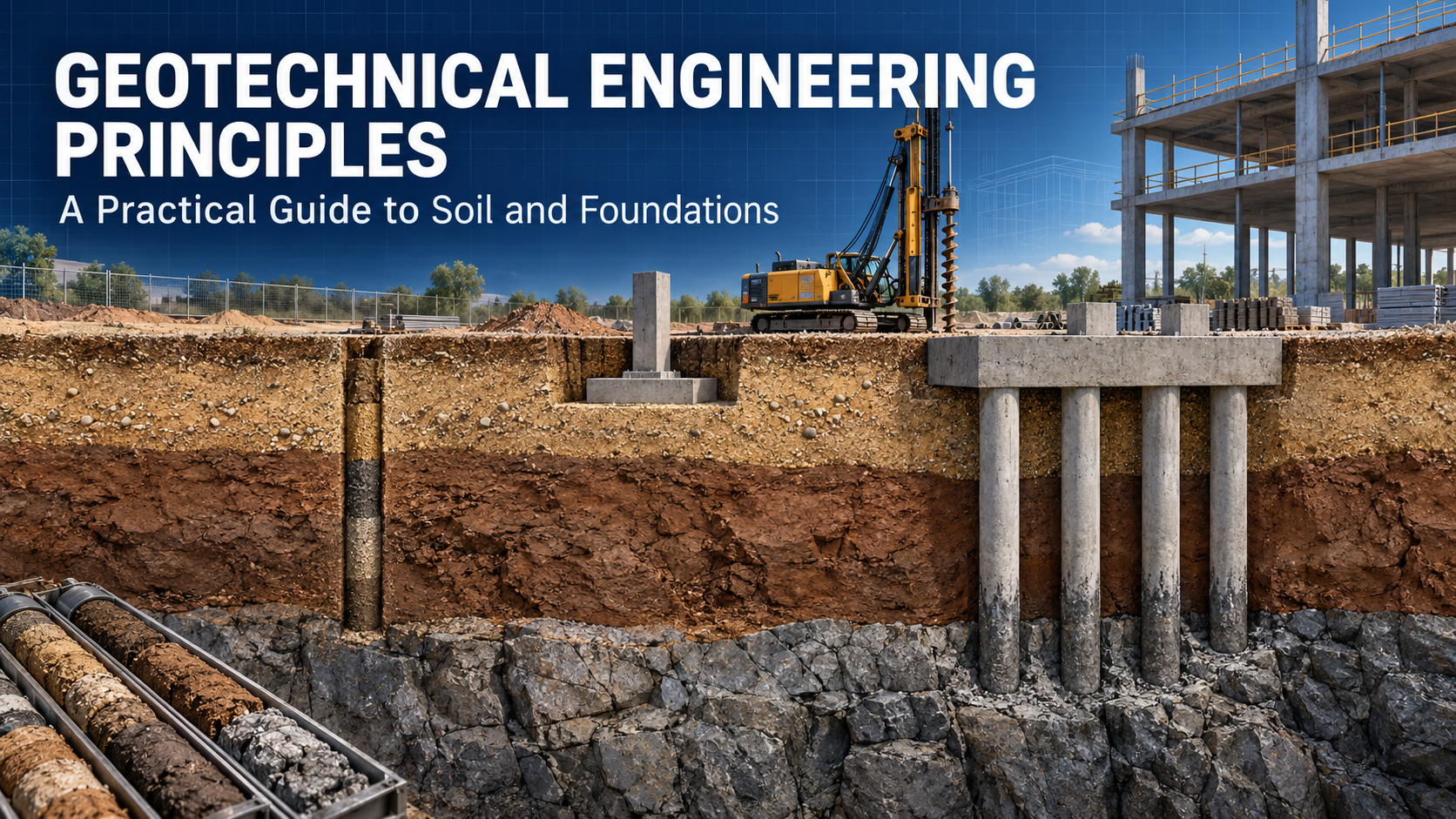
Geotechnical engineering explains how earth materials respond to loads, excavation, and changes in groundwater. Its central principles connect effective stress, shear strength, deformation, and drainage with decisions about foundations, slopes, and retaining structures.
Why can a footing support its load yet still settle too much? How can rainfall weaken a slope? And what can a few borings actually tell you about an entire property?
The answers begin with a practical limitation: natural deposits vary, and an investigation samples only part of them. Good analysis combines measurements, an understanding of how the deposits formed, and explicit assumptions about what lies between exploration points.
Imagine a building addition beside an existing facility. A nearby boring identifies dense sand, but the proposed footprint crosses an old filled drainage channel. Treating the entire area as uniform could overlook the layer that controls movement.
Engineering Principles provide a practical framework for weighing uncertainty, safety, and cost when you design around variable ground conditions.
Introduction to Geotechnical Engineering: Soils and Rocks
Geotechnical engineering deals with the interaction between the subsurface and the things people build on or within it. The discipline supports building foundations, embankments, excavations, tunnels, and earth-retaining systems.
Soil mechanics examines the behavior of particles, pore spaces, and pore fluids. Grain size matters, but particle arrangement, density, mineral composition, and stress history also influence the response.
Rock mechanics considers intact material and the discontinuities that divide a rock mass. A strong core sample does not establish that a fractured slope will remain secure. Joint orientation, spacing, weathering, and infilling may control its behavior.
Engineering geology helps explain those patterns. Depositional history, erosion, and previous land use guide where you investigate and which uncertainties deserve attention.
Classification gives you a shared vocabulary. It does not independently establish allowable loading, expected movement, or a suitable support system. Those decisions require properties and analyses relevant to the proposed work.
Mechanical Engineering Principles help explain how forces, loads, and material behavior influence the performance of foundations and retaining structures.
Soil Mechanics: Effective Stress and Groundwater
Effective stress describes the part of total normal stress that acts through the particle skeleton. For saturated soil, the familiar relationship is:
σ′ = σ − u
Here, σ′ represents effective normal stress, σ represents total normal stress, and u represents pore-water pressure.
For an illustrative calculation, suppose total stress at a point equals 120 kilopascals and pore pressure equals 40 kilopascals. Effective stress equals 80 kilopascals. If pore pressure rises to 70 kilopascals while total stress remains unchanged, effective stress falls to 50 kilopascals.
That reduction can decrease frictional resistance. It helps explain why groundwater affects bearing behavior and slope performance. The example holds total stress constant deliberately; an actual groundwater rise may also alter total stress and seepage forces.
Unsaturated material requires additional consideration of suction and saturation. Do not apply the saturated expression indiscriminately.
Seepage depends on hydraulic gradients and the ability of a deposit to transmit fluid. Upward flow can reduce effective stress and create problems at an excavation base. A drainage plan therefore needs to consider flow paths and exit gradients, not just the elevation of the visible surface.
A groundwater observation during drilling captures one moment. Seasonal fluctuations, perched zones, and delayed equilibration can produce a different picture later. Identify the groundwater scenario that matters for the decision. Applying Quality Engineering Principles to soil sampling, laboratory testing, and field documentation helps you catch errors before they affect your geotechnical recommendations.
Shear Strength and Stability
Shear strength describes resistance to sliding along a potential failure surface. A common effective-stress representation is the Mohr-Coulomb relationship:
τf = c′ + σ′n tan φ′
The parameters c′ and φ′ describe the strength envelope, while σ′n is effective normal stress on the plane. Select parameters that represent the relevant material, stress range, and drainage response.
Drained and undrained analyses answer different questions. Rapid loading of saturated clay may generate excess pore pressure because drainage cannot keep pace. Long-term behavior may require an effective-stress analysis after those pressures dissipate.
Do not mix an undrained strength with a drained framework without a justified method.
Slope stability also depends on geometry, surcharge loads, seepage, and the failure mechanism. An excavation at the toe can remove support; an embankment near the crest can increase driving forces.
A factor of safety reflects the selected model and inputs. It does not eliminate uncertainty in an overlooked weak layer or an unrealistic pore-pressure assumption.
Settlement, Consolidation, and Compaction
Adequate bearing resistance does not guarantee acceptable movement. A structure can avoid a shear failure and still experience settlement that damages finishes, utilities, or equipment alignment.
Immediate deformation occurs as loading changes stresses. Primary consolidation develops as excess pore pressure dissipates in a compressible saturated deposit. Secondary compression involves time-dependent deformation that can continue afterward.
Thickness, compressibility, drainage distance, and loading history influence the amount and timing of movement. Differential settlement often matters more than a uniform downward shift because adjacent parts respond differently.
Compaction uses mechanical effort to densify fill, typically by reducing air voids. Consolidation and compaction are different processes, even though both can reduce volume.
A laboratory moisture-density relationship helps establish placement criteria. Field acceptance must reference the specified method and material. “Ninety-five percent compaction” means little without identifying the reference maximum dry density and applicable moisture requirements.
Geotechnical Testing and Site Investigation
Plan exploration around the questions that could change the design. Review available records, inspect the site, and consider previous grading, buried channels, adjacent structures, and likely geological variability.
Borings provide samples and descriptions at selected locations. Cone penetration testing can provide detailed resistance profiles, but interpretation relies on appropriate correlations and context. Neither method reveals every feature between exploration points.
| Investigation component | Main contribution | Important limitation |
| Borings and sampling | Identify strata and obtain material for examination | Sampling can disturb the specimen |
| Penetration measurements | Characterize resistance and support correlations | Interpretation depends on equipment, procedure, and deposit |
| Laboratory soil testing | Evaluate classification, strength, and compressibility | Specimen quality and loading path affect results |
| Piezometers | Track hydraulic head at selected depths | Installation and monitoring duration influence interpretation |
Soil properties should match the analysis. An index value can support classification without supplying a defensible deformation parameter.
The FHWA’s Soils and Foundations Reference Manual connects exploration, parameter selection, and practical analysis. Its guidance supports engineering judgment rather than replacing investigation of the proposed work.
Build a subsurface model that distinguishes observations from interpretation. Show uncertain boundaries and explain why selected parameters represent the expected response. Add exploration where uncertainty could materially affect the outcome.
Foundation Design: Match Support to Performance
Foundation engineering connects structural demands with subsurface response. Evaluate load magnitude, eccentricity, lateral forces, uplift, and movement tolerances alongside the available support.
Shallow foundations transfer loads near the surface. Piles and drilled shafts transfer loads through shaft resistance, tip resistance, or both. Greater depth does not automatically produce a better solution.
Consider a lightly loaded addition over variable fill. Removal and replacement may offer a practical option if the unsuitable zone is limited. A thick compressible layer may require a different approach. Compare feasible alternatives using the actual profile and performance requirements.
Check both resistance and deformation. Deep foundations also need consideration of group behavior, installation effects, and possible downdrag from settling surrounding deposits.
For retaining structures, include earth pressures, drainage assumptions, movement constraints, and external loading. A rigid wall that cannot move enough to mobilize active pressure may require a different pressure model.
Ground Improvement and Reinforced Soil
Improvement methods modify subsurface behavior so a proposed facility can meet its requirements. Options include densification, preloading, drainage measures, inclusions, replacement, and binder treatment.
Select techniques according to grain size, depth, groundwater, nearby assets, and the property you need to improve. A method suitable for loose granular deposits may perform poorly in a highly plastic deposit.
Soil stabilization with a binder requires compatibility assessment and verification. Mineralogy, organics, and sulfate content can affect suitability. A successful application elsewhere does not establish performance for a different material.
Reinforcement combines tensile elements with compacted fill. Its performance depends on interaction, embedment, connections, durability, and drainage, as well as the strength of the reinforcement itself.
Define acceptance criteria before treatment begins. Specify what measurements will demonstrate the required improvement and what happens if the results fall short. Geotechnical design needs a verification plan that matches the intended mechanism.
Construction Observations and Verification
Geotechnical engineering continues as crews expose the subsurface. Compare actual findings with the investigation model and address meaningful differences before work conceals them.
An excavation may reveal soft pockets, unexpected seepage, or a layer that differs from the boring interpretation. Those observations can change the recommended preparation or support details.
Earthwork verification also considers lift thickness, moisture, density, and drainage. A passing result at one location does not characterize every placement area.
Dewatering deserves coordination with adjacent owners and environmental specialists where appropriate. Lowering groundwater can increase effective stress in compressible deposits and cause nearby settlement. Pumping may also affect contaminant migration or discharge requirements.
Use instrumentation when the risks justify it. Establish baseline readings, action thresholds, responsible reviewers, and predefined responses. Measurements provide protection only when someone interprets them and acts in time.
Sound engineering procedures connect the report, field observations, and final record. Document revised assumptions so future work does not rely on a superseded recommendation.
Frequently Asked Questions
What are the key concepts a beginner should understand?
Start with classification, effective stress, seepage, shear resistance, compressibility, and load transfer. Then connect each concept to a decision: support capacity, expected movement, excavation behavior, or drainage.
A useful introduction to geotechnical engineering covers field practices as well as equations. You need to understand how sampling and measurements influence the parameters you use.
Why do nearby projects sometimes need different recommendations?
Geotechnical engineers evaluate the combination of subsurface profile, loading, geometry, and performance requirements. Nearby locations can differ because of variable deposits, previous excavation, or buried fill.
Even with similar profiles, a vibration-sensitive machine and a flexible storage area may tolerate different movements. Recommendations belong to the investigated scope and assumptions.
What is the highest salary of a geotechnical engineer?
There is no single fixed maximum. Compensation depends on location, experience, specialization, leadership responsibilities, and ownership income.
The Bureau of Labor Statistics civil engineering profile provides broader occupational pay context. It does not establish a separate maximum for this specialty. Compare roles with similar responsibilities and distinguish salary from bonuses or business earnings.
Is there a PDF version of the ninth edition of Principles of Geotechnical Engineering?
Check the publisher or an authorized academic library for the ninth edition’s available digital formats. An eTextbook does not necessarily include a downloadable PDF; access and download permissions vary.
For additional study, MIT OpenCourseWare’s Advanced Soil Mechanics materials address effective stress, seepage, strength, and deformation. The course is advanced, so build familiarity with basic stress calculations and classification before tackling its more demanding material.
For study, match notes and worked solutions to the edition you actually use. Case studies and example problems help most when you explain the drainage assumptions, parameter selection, and limitations behind the answer.