
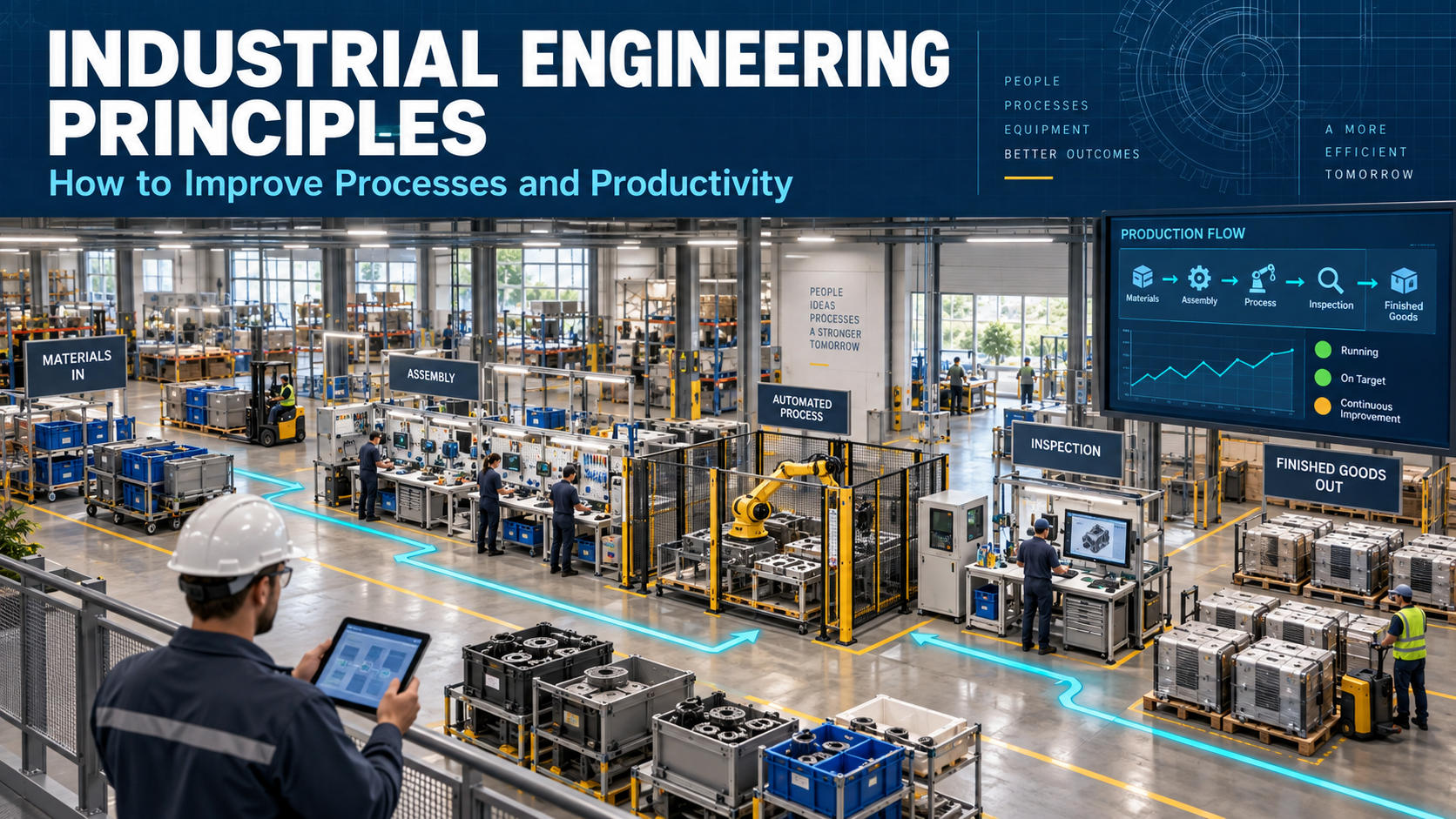
Why does a busy production line still miss delivery dates? Why do extra people barely reduce a backlog? And how can you increase output without making everyone rush?
Industrial engineering principles help you answer those questions by examining how people, equipment, materials, information, and time interact. The goal is to improve the whole system so it delivers reliable results with fewer delays, less waste, and a manageable workload.
That starts with observation. Before buying another machine or changing a schedule, understand what actually limits performance. A faster assembly station offers little benefit if every finished unit waits for an overloaded test bench.
The same thinking applies beyond factories. A hospital, distribution center, laboratory, or engineering office can all struggle with bottlenecks, unnecessary handoffs, and inconsistent methods. Engineering Principles help you weigh productivity gains against cost, safety, and reliability when improving an industrial system.
What Is Industrial Engineering?
Industrial engineering focuses on designing and improving integrated systems. Its scope includes the equipment that performs a task, the person operating it, the material arriving upstream, and the information that tells everyone what happens next.
The U.S. Bureau of Labor Statistics describes the profession as combining people, machines, materials, information, and energy to produce goods or deliver services. Its examples extend into manufacturing, healthcare, and transportation.
Think about a warehouse that ships orders late. You could ask employees to pick faster. But the real delay might come from incomplete inventory records, long walking routes, or a packing station that receives every order at once.
An industrial engineering approach follows the order from receipt through shipment. It measures each stage, checks the handoffs, and identifies the constraint before recommending a change.
The discipline draws on mathematics, statistics, behavioral science, and economics. It also overlaps with systems engineering, particularly when evaluating interactions and tradeoffs across a larger system.
Historical approaches such as scientific management emphasized systematic study of tasks. A sound modern approach also considers safety, human capabilities, employee participation, and the consequences of local efficiency targets.
A stopwatch can tell you how long something takes. It cannot tell you whether the task should exist, whether the method creates strain, or whether finishing it faster helps the customer.
Mechanical Engineering Principles help you understand equipment loads, energy use, and physical limits before you change a production process.
Core Principles: Improve the Whole System
There is no single universal numbered list that covers every industrial engineering assignment. The following five ideas provide a practical starting point:
- Define the result the customer needs. Specify acceptable performance, delivery timing, and safety constraints before choosing a solution.
- Study the entire flow. Include queues, transportation, approvals, and rework, not just the steps that transform the product.
- Measure actual conditions. Observe representative shifts, product types, and demand levels instead of relying on one unusually good day.
- Design for people and variability. Account for fatigue, interruptions, equipment failures, and differences between tasks.
- Verify the improvement. Compare results against a baseline and check whether another part of the system became worse.
These ideas turn the application of engineering principles into something practical: a clear decision about what to change and how to judge the outcome. Applying Engineering Management Principles helps you assign responsibility, secure resources, and turn process improvements into changes your team can sustain.
Define Success Before Choosing a Tool
Suppose a laboratory wants to reduce turnaround time. Its team needs a precise definition: time from sample receipt to an approved result, perhaps, rather than time spent inside the analyzer.
That choice matters. Faster analysis might save three minutes while samples still wait six hours for review.
Set a measurable goal and include safeguards. A target such as “reduce median turnaround from 18 hours to 12 hours without increasing repeat tests” gives the team a clearer direction than “be more efficient.” Track unusually long waits too; a better median can hide a worsening tail.
Avoid Local Efficiency Traps
Imagine a cutting station that produces 90 parts per hour and a downstream station that finishes 60. Increasing cutting output to 110 parts per hour will not raise the line’s sustained finished output above the downstream limit.
Instead, unfinished inventory accumulates unless you adjust the release rate.
Productivity measures should reflect useful output relative to resources consumed. Keeping every machine busy can look impressive while increasing storage, handling, and delivery time.
Process Optimization: Measure Flow and Find Constraints
Start with a simple map of the current sequence. Follow one item, order, or request. Record where it stops, who touches it, and what information each person needs.
Distinguish processing time from waiting time. A purchase request might need only 20 minutes of attention yet take four days to reach approval. Those four days tell you something that a task timing study alone would miss.
Industrial engineers use several time measures, but each answers a different question.
| Measure | Question it answers | Example |
| Takt time | How frequently must we finish a unit to meet demand? | One unit every 2 minutes |
| Station cycle time | How long does the station take to repeat its cycle? | 2.5 minutes per unit |
| Lead time | How long does an item take from a defined start to finish? | 3 days from order release to shipment |
| Throughput | How many units does the system complete per period? | 24 acceptable units per hour |
| Work in process | How many items have entered but not yet finished? | 72 orders within the defined boundary |
Compare Capacity with Demand
The Lean Enterprise Institute defines takt time as available production time divided by customer demand.
Assume a production cell has 420 available minutes per shift after planned breaks. Customers need 210 units per shift.
Takt time = 420 minutes ÷ 210 units = 2 minutes per unit.
Now suppose one station completes a unit every 2.5 minutes. With one unit per cycle, no downtime, and no rejected units, its theoretical capacity equals 168 units per shift.
That station cannot support demand under those assumptions. You might redistribute tasks, shorten setup activities, or add parallel capacity. Asking everyone to “keep up” does not close the arithmetic gap.
Actual performance also depends on availability, product mix, and rework. A nominal cycle time equal to takt leaves little room for unplanned losses, so test the full capacity assumptions.
Use Little’s Law Carefully
For a stable system with consistent boundaries, Little’s Law relates average inventory, average throughput, and average flow time:
Average inventory = average throughput × average flow time.
If a repair center averages 72 open jobs and completes 24 jobs per day, the implied average flow time equals three days. Count the same job population throughout the calculation, and use a representative period without a continually growing backlog.
This relationship helps you check whether a proposed schedule makes sense. It does not prove that removing inventory alone will increase throughput. Cut a needed buffer too aggressively, and a downstream station may run out of material.
Lean Practices: Remove Waste Without Overloading People
Lean manufacturing encourages teams to examine activities that consume time or resources without delivering customer value. Common examples include unnecessary movement, excess inventory, waiting, defects, and overproduction.
You can apply that thinking to service settings too. Reentering the same project details into three systems creates effort and opportunities for mistakes, even if every department considers its own form essential.
Start by asking what purpose each step serves. Some activities do not directly transform the product but still support safety, traceability, or regulatory obligations. Understand those requirements before deleting a step.
Improve the Method Before Increasing the Pace
Consider an assembly bench where the operator reaches behind the chair for fasteners 40 times per hour. Moving the bin within a comfortable reach may shorten the task and reduce awkward movement.
The benefit comes from a better layout. Nobody needs to move faster.
A similar opportunity appears when technicians search for shared tools. Point-of-use storage, clear locations, and a sensible replenishment routine can remove the search entirely.
Standardized methods then help preserve the improvement. Document the safe sequence, critical checks, and material needs with the people who perform the task. Treat that method as the current baseline, and revise it when testing reveals a better approach.
Choose Buffers Deliberately
Lower inventory can expose interruptions, but zero inventory is not a universal design target. A critical component with uncertain replenishment may justify a buffer.
Set buffer levels using demand, replenishment time, variability, and the consequences of a shortage. Review them when those conditions change.
Continuous improvement works best as a repeatable cycle: identify a specific issue, test a change, compare results, and update the method. Small trials give you evidence before a facility-wide rollout.
Quality Control: Understand Variation and Prevent Errors
Average performance tells only part of the story. Two filling machines might deliver the same average volume while one produces a much wider spread.
That spread matters. Customers receive individual containers, not the average container.
Industrial engineering uses statistical methods to distinguish routine variation from evidence that something changed. The NIST guidance on process monitoring explains how statistical techniques help teams monitor performance and detect changes.
Separate Stability from Acceptability
Control limits describe the variation that a suitable statistical chart expects from the process. Specification limits describe what the product or customer requires.
Those limits serve different purposes.
A stable process can still produce unacceptable output. Conversely, measurements inside specifications do not guarantee that the underlying process remains stable.
Before calculating capability indices, check the measurement system, stability, sampling approach, and distribution assumptions. A precise-looking number cannot repair unreliable measurements.
Also define the denominator. “Five defects” means something different across 100 inspected units than across 10,000, and a single unit may contain several defects.
Prevent Mistakes at Their Source
Suppose operators sometimes install a bracket backward. Another final inspection may catch the error, but an asymmetric fixture could prevent incorrect placement earlier.
That change removes a failure path instead of relying entirely on attention.
Use a trial to check whether the fixture introduces another concern, such as pinch points or difficulty handling variant parts. Then confirm that the defect rate falls across representative operators and shifts.
Good corrective action explains why the failure occurred and changes the conditions that allowed it. “Be more careful” rarely provides that explanation.
Design Tasks Around Human Capabilities
People form part of engineering systems, and their capabilities vary. A station that suits one tall, experienced employee may frustrate someone shorter or unfamiliar with the task.
Ergonomics addresses that fit. NIOSH recommends designing the workplace around employees’ capabilities and limitations, including the tools, equipment, and physical environment they use.
Reduce Physical and Mental Demands
For a packing station, examine reach distances, lifting frequency, grip requirements, and working height. An adjustable bench or lift-assist device may address the cause of strain more effectively than repeated reminders about posture.
Consider mental demands as well. Similar part numbers, crowded displays, and ambiguous instructions make errors easier. Clear labeling and well-designed confirmation steps can help people make the right decision under normal production pressure.
Ask workers where they improvise. A homemade guide or handwritten note may reveal an unmet design need.
Observe representative tasks and involve qualified specialists when evaluating significant ergonomic risks. One quick observation cannot establish that a lifting task remains acceptable throughout a shift.
Include Employees in the Trial
A proposed redesign may shorten travel but make replenishment awkward. The person operating the station can often identify that tradeoff during a simple mockup.
Use temporary layouts, sample parts, and realistic task sequences before committing to equipment changes. Check cleaning, maintenance access, and emergency access too.
The design needs to function on a normal Tuesday, including interruptions and less experienced staff. A demonstration by the fastest operator does not establish a sustainable standard.
Operations Engineering and Management: Choose Sustainable Improvements
Once you understand the constraint, compare alternatives. Operations research can help evaluate routing, scheduling, staffing, and inventory decisions using mathematical models.
Choose a method that fits the question. A spreadsheet may answer a straightforward capacity calculation. A simulation may help when queues, shared equipment, and variable arrival times interact.
In operations engineering, the model supports a decision; it does not replace observation or judgment.
Compare Total Cost and Real Benefits
Suppose a fixture costs $12,000 and saves one minute on each of 30,000 units per year. That equals 500 hours of potential annual capacity.
At an assumed labor value of $40 per hour, the arithmetic suggests $20,000 annually. But those hours do not automatically become cash savings. The business needs to reduce paid overtime, avoid additional hiring, or use the capacity for valuable output.
Include maintenance, training, installation downtime, and consumables in the comparison. A simple payback calculation can screen alternatives, while larger investments may require discounted cash-flow analysis and sensitivity testing.
Automation deserves the same scrutiny. Verify product variation, changeovers, failure recovery, and service needs before assuming a machine will deliver its advertised output.
Make the Result Last
Operations management should assign ownership of the revised method, its measures, and its response plan. Otherwise, the original habits may return as soon as the project team leaves.
Track a small, balanced set of indicators. Finished output, delivery reliability, rejected units, and safety observations together provide more context than machine utilization alone.
Compare similar demand conditions and product mixes. If output improves during an unusually easy production week, avoid crediting the entire gain to the change.
Document what you tested, what assumptions held, and what would trigger another review. Sustainable improvement needs that follow-through.
Industrial Engineering FAQs
What Are the Basic Concepts of Industrial Engineering?
The main concepts include system performance, flow, capacity, variation, human factors, and economic tradeoffs. Together, they help you understand how individual tasks affect a larger outcome. Start with a defined customer need, observe the current method, and identify the constraint before selecting a tool.
What Exactly Do Industrial Engineers Do?
They study existing methods, develop alternatives, and test whether changes improve results. Industrial engineering examples include balancing an assembly line, reducing hospital waiting times, improving warehouse layouts, and scheduling shared equipment. The assignment often involves both technical calculations and conversations with the people who perform the tasks.
What Skills and Degree Do You Need?
Useful skills include statistics, problem solving, process mapping, communication, and engineering economics. Spreadsheet modeling and basic programming also help. An industrial engineering degree commonly includes production planning and statistical coursework; employers may also accept related engineering degrees. The BLS career profile linked above outlines typical entry requirements and job duties.
What Should You Know About Jobs and Salary?
Industrial engineering jobs span manufacturing, logistics, consulting, and service settings. Titles and responsibilities vary, so compare the actual assignment rather than the title alone. For an industrial engineering salary benchmark, use the BLS wage figures alongside regional and industry information. A national median includes experienced professionals and does not represent a guaranteed starting salary.
How Can You Apply These Ideas to a First Project?
Choose one recurring delay you can observe directly. Define where the task begins and ends, collect a representative baseline, and test one manageable change. Confirm the result with the people involved. A small improvement that survives ordinary conditions teaches more than an elaborate proposal nobody implements.