
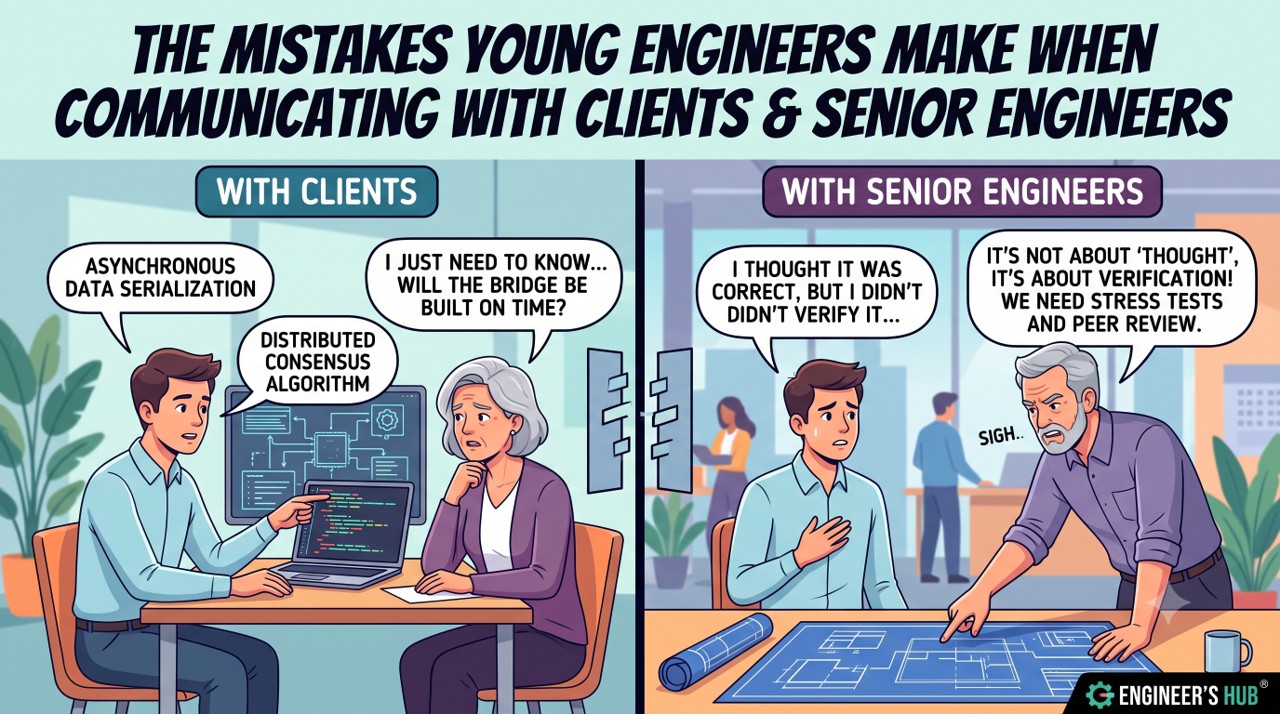
Technical ability is important in engineering, but communication is often what determines whether people trust your work.
Young engineers usually spend a lot of time developing calculations, design skills, software knowledge, field judgment, and technical understanding. Those skills matter. But as your career progresses, you also need to explain your work, ask good questions, write clearly, respond professionally, and keep people informed.
This is where many young engineers struggle.
The problem is not that they are careless or unprofessional. Most young engineers want to do good work. The challenge is that communication in engineering is different from communication in school. In school, you often explain what you know. In professional practice, you need to communicate so other people can make decisions, manage risk, meet deadlines, and understand what needs to happen next.
Here are some common mistakes young engineers make when communicating with clients, managers, and senior engineers.
Waiting Too Long to Give an Update
One of the most common mistakes young engineers make is staying quiet for too long.
You may be working hard on an assignment. You may be trying to figure out a problem before bothering anyone. You may think it is better to wait until you have a complete answer before giving an update.
But silence creates uncertainty.
Your manager may not know whether the task is on schedule. A senior engineer may not know whether you need help. A client may assume nothing is happening. A small issue may become a bigger problem simply because no one knew about it early enough.
You do not need to send constant updates. But you should communicate when something affects schedule, scope, quality, assumptions, or decisions.
A simple update can be enough:
“I reviewed the data and found one issue that may affect the schedule.”
“I am waiting on one item before I can finalize the draft.”
“I have a preliminary answer, but I want to confirm it before we send it to the client.”
“I am still working through the calculation and may need input this afternoon.”
These updates show ownership. They help other people plan. They also build trust because people know they will not have to chase you for information.
Asking Vague Questions
Young engineers should ask questions. That is part of learning.
The problem is asking questions that are too vague.
For example, saying “I do not understand this” may be true, but it does not help the senior engineer know where to start. Saying “What should I do?” without explaining what you have already reviewed can make it look like you have not tried to think through the issue.
A better approach is to ask specific questions.
Instead of saying:
“I do not understand the design.”
Try saying:
“I understand the layout and the design flow, but I am not clear on why we selected this pipe size instead of the next smaller size. I checked the calculation, and it looks like velocity may be the controlling factor. Is that right?”
That question shows effort. It shows what you already understand. It identifies the specific point of confusion. It gives the senior engineer something useful to respond to.
Before asking a question, try to identify three things:
What do I understand?
What exactly am I unsure about?
What have I already checked?
This habit makes your questions better and helps you learn faster.
Giving Too Much Detail Too Soon
Engineers like details. Details matter.
But not every conversation needs every detail at the beginning.
Young engineers sometimes explain everything they did before getting to the point. They describe the background, the data, the calculation, the side issue, the exception, the second exception, and then finally the actual question.
By that time, the listener may be confused or impatient.
When communicating with managers, senior engineers, or clients, start with the main point.
For example:
“The design still works, but the safety factor is lower than expected.”
“We found a conflict between the drawing and the field condition.”
“The schedule may slip because we are missing the survey file.”
“The calculation checks out, but I want a senior review before we issue it.”
Then provide the supporting details.
This is especially important with clients. Most clients do not want a long technical explanation before they understand why the issue matters. They need to know what happened, why it matters, what the options are, and what you recommend.
A good structure is:
What is the issue?
Why does it matter?
What are the options?
What do we recommend?
That approach makes your communication clearer and more useful.
Sounding More Certain Than You Really Are
Young engineers sometimes feel pressure to sound confident, especially in front of clients or senior staff.
Confidence is good. False certainty is not.
If you are not sure, do not pretend. Engineering decisions can affect cost, safety, compliance, construction, and public welfare. Guessing can create real problems.
It is better to say:
“I need to verify that before I give a final answer.”
“I believe that is correct, but I want to confirm the code requirement.”
“I do not want to overstate this until we review the field data.”
“I can give you a preliminary answer now, but I recommend we confirm it before making a decision.”
This kind of communication does not make you look weak. It makes you look responsible.
Experienced engineers do this all the time. They know when an answer can be given immediately and when it should be checked.
The goal is not to sound certain. The goal is to be accurate, clear, and trustworthy.
Hiding Problems Until They Are Bigger
Another serious communication mistake is delaying bad news.
Maybe a calculation is not working. Maybe a drawing has an error. Maybe the field condition does not match the plan. Maybe you missed something in a report. Maybe the task is taking longer than expected.
It can be tempting to keep working quietly and hope you can fix it before anyone finds out.
Sometimes that works. Often it does not.
In engineering, small problems are usually easier to solve early. They become more difficult when people find out too late.
If you discover a problem, communicate it professionally. Do not panic. Do not blame someone else. Do not hide it.
Start with the facts:
“During my review, I found a discrepancy between the plan and the field notes.”
“The calculation does not support the assumption we used in the first draft.”
“I found an error in the table, and I am checking whether it affects the conclusion.”
“I underestimated the time needed for this task. I can complete it tomorrow morning, but not by the end of today.”
Managers and senior engineers do not expect young engineers to be perfect. They do expect them to raise issues responsibly.
Writing Emails That Are Too Long or Too Unclear
Email is a major part of professional engineering communication, and it is easy to get wrong.
Some young engineers write emails that are too long. Others write emails that are too short and leave out important context. Some bury the request at the bottom. Others send messages without a clear next step.
A good engineering email should make it easy for the reader to understand what is happening and what is needed.
Use a clear subject line. Start with the purpose of the email. Keep paragraphs short. Use bullets when several items need attention. Make the requested action obvious.
For example:
“I reviewed the draft report and have two questions before finalizing the section.”
“The contractor submitted the attached product data. I recommend approval, but I would like your review of the pressure rating.”
“We need a decision on the layout by Friday to maintain the schedule.”
Before sending an email, ask yourself:
Will the reader know why I am sending this?
Will they understand what decision or action is needed?
Did I include enough context without overwhelming them?
Did I attach the correct file?
A well-written email saves time and reduces confusion.
Using Technical Language Without Explaining the Point
Technical language is necessary in engineering, but it should not be used to hide the main point.
Young engineers sometimes rely heavily on technical terms because they want to sound professional. The result can be communication that is technically accurate but difficult for clients, non-technical managers, or junior staff to understand.
The best engineers can explain complex ideas clearly.
That does not mean oversimplifying the work. It means translating technical information into useful meaning.
For example, instead of saying only:
“The hydraulic grade line exceeds the rim elevation under the modeled condition.”
You might say:
“The model shows that water could surcharge above the manhole rim during this storm event, which means there may be a flooding risk at this location.”
The second version explains why the technical result matters.
Clients and decision-makers need to understand consequences, not just terminology.
Not Listening Carefully
Communication is not only about what you say. It is also about how well you listen.
Young engineers sometimes focus so much on preparing their answer that they miss what the other person is really asking.
A client may not be asking for a detailed calculation. They may be asking whether a decision affects schedule. A senior engineer may not be asking whether you completed a task. They may be asking whether you understood the risk. A contractor may not be challenging your design. They may be trying to explain a field constraint.
Good listening requires patience.
Before answering, make sure you understand the question. If needed, repeat it back:
“Just to make sure I understand, you are asking whether this change affects the permit submittal, correct?”
“Are you mainly concerned about cost, schedule, or technical performance?”
“Do you want a quick recommendation now or a more detailed review?”
These questions prevent misunderstandings and make your response more useful.
Treating Senior Review as a Personal Criticism
Review comments are part of engineering practice.
A senior engineer may mark up your report, revise your calculation, question your assumptions, or rewrite parts of your email. That can feel frustrating, especially when you worked hard.
But review comments are not an attack. They are part of the quality process and part of your training.
The mistake is becoming defensive too quickly.
Instead of reacting with, “But I did it this way because…” try asking:
“Can you explain why you changed that?”
“What should I watch for next time?”
“Is this a technical issue or more of a communication issue?”
“Would this level of detail be too much for a client deliverable?”
These questions turn review comments into learning opportunities.
Senior engineers are more likely to invest time in young engineers who accept feedback professionally and improve from it.
Failing to Close the Loop
One of the simplest ways to build trust is to close the loop.
If someone asks you to check something, let them know when it is checked. If you say you will follow up, follow up. If a client asks a question and you need time to answer, acknowledge it and then respond when you have the answer. If a senior engineer gives you comments, confirm when they have been addressed.
Do not leave people wondering.
Closing the loop can be as simple as:
“I made the revisions and uploaded the updated file.”
“I confirmed the requirement with the state guidance.”
“The vendor responded, and the revised data sheet is attached.”
“I checked the calculation, and the original result is still valid.”
This habit is small, but it has a big effect on how people see you.
Reliable follow-through is one of the main reasons young engineers earn more responsibility.
Bottom Line
Young engineers do not need to be perfect communicators, but they do need to improve intentionally.
Good communication helps projects run better. It helps managers trust you. It helps clients understand the work. It helps senior engineers train you. It also reduces mistakes, delays, and confusion.
The biggest mistakes to avoid are waiting too long to update people, asking vague questions, giving too much detail before the main point, sounding more certain than you really are, hiding problems, writing unclear emails, using technical language without explaining the meaning, listening poorly, taking review comments personally, and failing to close the loop.
The good news is that every one of these habits can be improved.
Start with the basics. Communicate early. Be clear. Ask specific questions. Explain the point before the details. Be honest about uncertainty. Raise problems before they grow. Listen carefully. Learn from feedback. Follow through.
Technical skill may get your work started.
Good communication helps people trust you with more of it.