
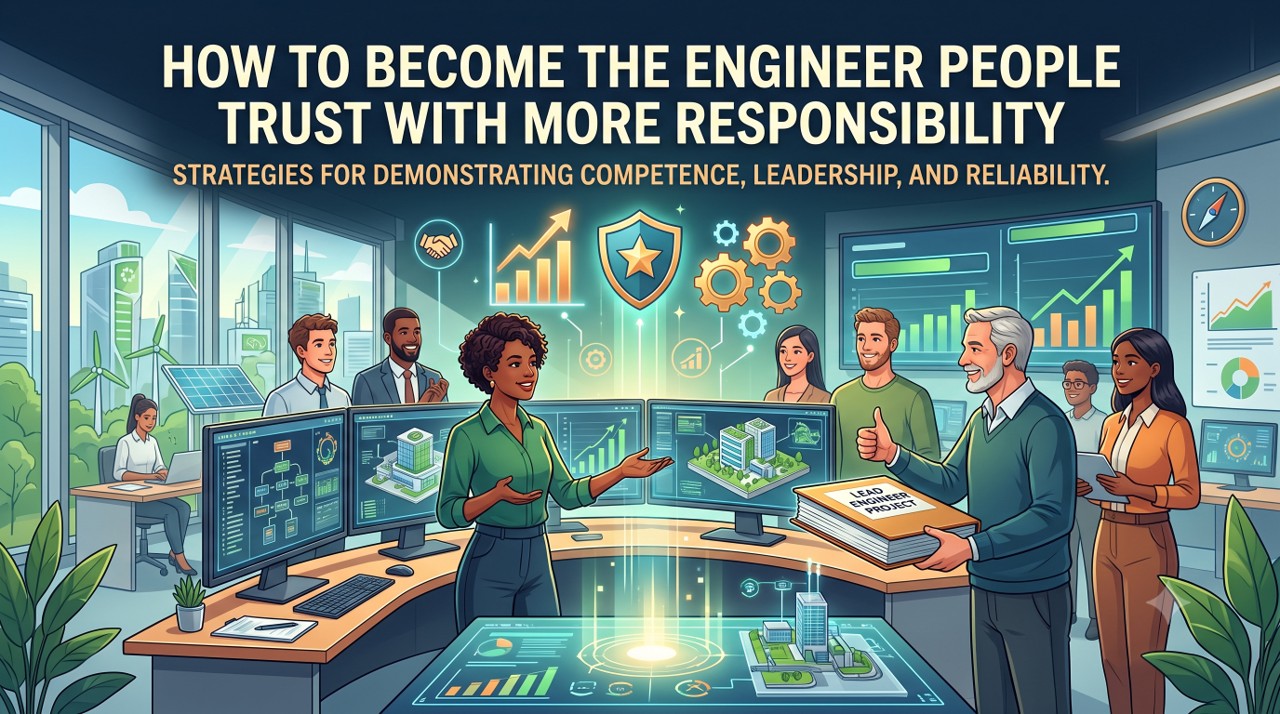
Early in your engineering career, one of the biggest signs of growth is not your title. It is not how many years of experience you have. It is not even whether you have passed the PE exam.
One of the clearest signs that you are becoming a stronger professional is this: people start trusting you with more responsibility.
That trust does not happen all at once. It builds gradually. A project manager asks you to handle a client update. A senior engineer gives you more freedom on a design task. A team leader includes you in a difficult meeting. Someone asks for your opinion before making a decision. Eventually, people begin to see you as someone who can be counted on, not just someone who can complete assigned work.
For young engineers, especially those in their 20s, this is one of the most important career transitions. You move from being the person who waits for instructions to the person who takes ownership.
So how do you become the engineer people trust with more responsibility?
Do What You Say You Will Do
This sounds simple, but it is one of the most important professional habits you can build.
If you tell someone you will send a calculation by Thursday, send it by Thursday. If you say you will review a drawing, review it. If you are asked to follow up with a vendor, do not let it sit in your inbox for a week.
Reliability is one of the foundations of trust.
Young engineers sometimes assume that trust comes from technical brilliance alone. Technical ability matters, but people also pay close attention to whether you follow through. A project manager is much more likely to give you responsibility if they know you will not quietly drop the ball.
If something changes, communicate early. If you are behind, say so before the deadline. If you are stuck, ask for help before the problem becomes urgent.
Responsibility does not mean you never run into issues. It means people do not have to chase you to find out what is happening.
Learn to Communicate Before People Have to Ask
One of the fastest ways to build trust is to keep people informed.
Many young engineers do good work but stay too quiet. They work on an assignment, run into questions, make progress, hit a delay, and say very little until someone asks for an update. That creates uncertainty for everyone else.
A trusted engineer communicates before being asked.
That does not mean sending long emails every hour. It means giving useful updates at the right time. For example:
“I reviewed the drawings and found two items that need clarification.”
“I am waiting on the survey file before I can finish the layout.”
“I completed the first draft and will send it for review this afternoon.”
“I think we may have a scope issue, and I want to flag it before we go further.”
These updates show awareness, judgment, and ownership. They also help managers and senior engineers plan around your work.
Good communication is not just about sounding professional. It is about reducing uncertainty for the people who depend on you.
Take Ownership of the Result, Not Just the Task
There is a big difference between completing a task and owning an outcome.
A task-focused engineer says, “I did what I was asked to do.”
An ownership-focused engineer asks, “Did this solve the problem?”
That mindset matters.
For example, suppose you are asked to prepare a table for a report. A task-focused approach is to fill in the table and send it back. An ownership-focused approach is to check whether the numbers make sense, whether the table is complete, whether the units are clear, and whether the information supports the purpose of the report.
The same applies to drawings, calculations, inspections, field notes, meeting summaries, and client deliverables.
When you take ownership, you start seeing your work in context. You ask better questions. You catch issues earlier. You become more useful to the team.
That is when people begin giving you more responsibility.
Be Honest About What You Know and What You Do Not Know
Young engineers sometimes feel pressure to have all the answers. That pressure is understandable, especially when you are working with experienced professionals, clients, contractors, or regulators.
But pretending to know something is dangerous.
Trusted engineers are honest about uncertainty. They do not bluff. They do not guess when the consequences matter. They do not act confident just to avoid looking inexperienced.
There is nothing wrong with saying:
“I need to verify that before I answer.”
“I understand part of the issue, but I want to check the code requirement.”
“I have not handled that before, but I can research it and follow up.”
“That may be correct, but I want to confirm it before we make a decision.”
This kind of honesty builds credibility. It shows that you respect the work and understand the responsibility that comes with engineering decisions.
Confidence is important, but accurate confidence is much better than false confidence.
Make Your Manager’s Job Easier
If you want more responsibility, pay attention to what your manager or senior engineer has to manage.
They are usually thinking about more than the technical task in front of you. They are managing budgets, schedules, client expectations, quality control, risk, staffing, and deadlines. If you understand those pressures, you can become much more valuable.
Before asking a question, organize your thoughts. Instead of saying, “What should I do?” try saying:
“Here is the issue I found. I see two possible options. I think Option A is better because of the schedule, but I want your input before I proceed.”
That kind of question shows judgment. It also makes it easier for your manager to help you.
Another way to make your manager’s job easier is to identify problems early. Do not wait until the day before a deadline to mention that something is missing. Do not assume someone else noticed a conflict. Do not ignore a small issue because you are afraid to bring it up.
A trusted engineer does not hide problems. A trusted engineer helps the team see and solve problems sooner.
Pay Attention to Quality
Quality is one of the quickest ways to earn trust, and one of the quickest ways to lose it.
If your work repeatedly has careless errors, people will hesitate to give you more responsibility. That does not mean you are expected to be perfect. It means you should care enough to check your work before handing it off.
Review your calculations. Check units. Read your emails before sending them. Make sure attachments are included. Confirm that dates, names, labels, and drawing references are correct. Compare your work against the assignment. Look for obvious mistakes before someone else has to find them.
Senior engineers understand that young engineers are still learning. They expect to review your work. But there is a difference between review comments that help you develop and review comments that come from avoidable carelessness.
When people see that you take quality seriously, they become more comfortable giving you work that matters.
Understand the Business Side of Engineering
Engineering work does not happen in a vacuum. It happens inside projects, contracts, budgets, deadlines, and client relationships.
Young engineers who understand this context often advance faster.
You do not need to know everything about business development or project management right away. But you should start paying attention. How is the project scoped? What is included and what is not included? What are the deliverables? What is the schedule? Who is the client? What does success look like?
When you understand the business side, you make better technical decisions. You also begin to see why communication, responsiveness, documentation, and judgment matter so much.
A technically correct answer is important. A technically correct answer delivered late, over budget, or without understanding the client’s need may still create problems.
Trusted engineers understand both the technical work and the project context.
Stay Calm Under Pressure
Engineering projects can become stressful. Deadlines move. Clients change direction. Contractors call from the field. Data is incomplete. Something does not work as expected. A drawing goes out with an error. A regulator asks a difficult question.
The way you respond under pressure affects how people see you.
You do not need to be emotionless. You do not need to have an instant answer. But you should try to stay steady, professional, and solution-focused.
When something goes wrong, avoid blame as your first reaction. Start with the facts. What happened? What is the impact? Who needs to know? What are the options? What is the next responsible step?
Young engineers who stay calm and constructive during difficult moments stand out. They become the people others want in the room when things are not easy.
Keep Learning After the Assignment Is Finished
The engineers who grow the fastest do not just finish work. They learn from it.
After a task or project, ask yourself what you learned. What would you do differently next time? What did the senior reviewer change? What questions did the client ask? What did you misunderstand at first? What skill would help you perform better next time?
This is where continuing education can be valuable. Do not think of PDH courses only as a license renewal requirement. Use them to strengthen areas that matter to your career: technical knowledge, ethics, codes and standards, project management, communication, leadership, and professional judgment.
The goal is not just to collect credits. The goal is to become more capable.
Build Trust One Assignment at a Time
Trust is built through repeated evidence.
You follow through. You communicate clearly. You check your work. You ask good questions. You admit what you do not know. You learn from feedback. You understand the bigger picture. You handle pressure professionally.
None of these habits require you to be the most experienced engineer in the room. They require intention, consistency, and maturity.
That is good news for young engineers.
You may not control your years of experience yet. You may not control your title. You may not control which projects come across your desk.
But you can control how you show up.
The bottom line is this: engineers earn more responsibility when people trust their judgment, reliability, communication, and ownership. Technical skill matters, but trust is what causes people to hand you larger assignments, invite you into important conversations, and rely on you when the work becomes more complex.
If you want to become the engineer people trust with more responsibility, start with the basics. Do good work. Communicate early. Own the outcome. Keep learning. Be honest. Follow through.
Over time, those habits become your reputation.