
Professional development is easy to postpone. Engineers are busy with projects, deadlines, clients, design reviews, reports, field work, meetings, and license renewal requirements. It is common for continuing education to become something that gets handled late in the renewal cycle, often when a deadline is already approaching.
But professional development should not be treated as a last-minute task.
For licensed professional engineers, continuing education is often required for PE license renewal. Depending on the state, engineers may need to complete a certain number of Professional Development Hours, or PDH, during each renewal period. Some states require ethics. Others require laws and rules courses. Some accept online courses, while others have specific requirements for live or interactive training.
Those requirements matter. Engineers need to stay compliant with the rules of every state where they hold a license. But professional development can do more than satisfy a state board requirement. When planned well, it can help engineers stay technically current, strengthen judgment, improve communication, prepare for new responsibilities, and support long-term career growth.
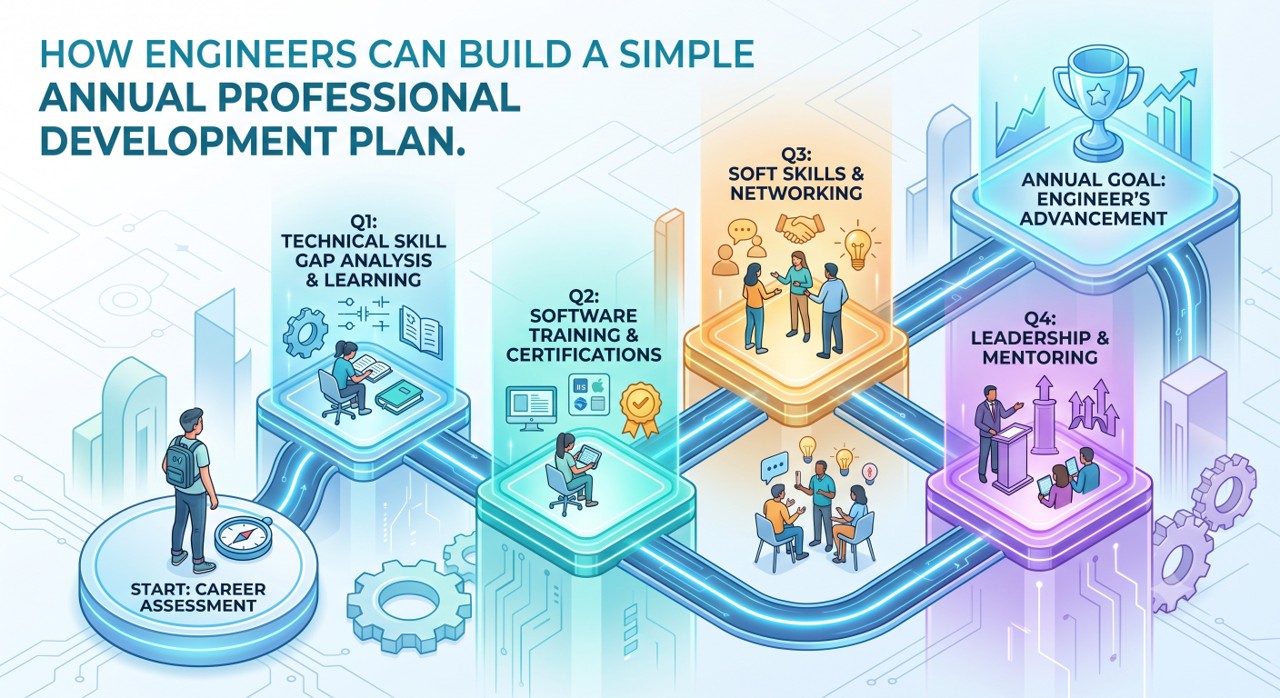
The good news is that an annual professional development plan does not need to be complicated. A simple plan, created once a year and updated throughout the year, can help engineers choose better courses, avoid renewal stress, and get more value from continuing education.
Why Engineers Should Have a Professional Development Plan
Many engineers complete continuing education only because they have to. They wait until renewal time, look for available courses, earn the required credits, download certificates, and move on.
That approach may satisfy the requirement, but it often misses the bigger opportunity.
Engineering changes constantly. Codes are updated. Standards evolve. Regulations change. New technologies are introduced. Software tools become more advanced. Safety expectations shift. Project delivery methods improve. Clients and employers expect engineers to understand current practice, not just what they learned years ago.
A professional development plan helps engineers stay intentional.
Instead of asking, “What courses can I take quickly before renewal?” the better question is:
“What knowledge would make me a more competent, current, and valuable engineer this year?”
That shift changes the purpose of continuing education. It turns PDH from a compliance task into a career tool.
Step 1: Start With Your License Requirements
The first step is practical: understand your continuing education requirements.
Before choosing courses, engineers should review the rules for every state where they hold a license. This is especially important for engineers licensed in multiple states because requirements can vary significantly.
Important items to confirm include:
- Number of PDH or continuing education credits required
- Renewal period and deadline
- Ethics requirements
- Laws and rules requirements
- Limits on self-paced online courses
- Requirements for live or interactive courses
- Whether providers must be approved
- Whether carryover credits are allowed
- Documentation and record retention rules
This step keeps the plan grounded. Professional development should support career growth, but it also needs to satisfy the actual licensing requirements that apply.
A simple spreadsheet can be useful. Create columns for the state, renewal deadline, total credits required, ethics requirement, laws and rules requirement, completed credits, and remaining credits. Engineers with multiple licenses may want one row for each state.
The goal is to avoid surprises. No engineer wants to discover late in the renewal cycle that they are missing a required ethics course, live webinar, or state-specific laws and rules credit.
Step 2: Identify the Work You Actually Do
After confirming license requirements, the next step is to look at your current engineering work.
Professional development should connect to real responsibilities. Engineers should choose courses that help them perform their work more effectively, make better decisions, and understand the issues they are likely to encounter.
Start by asking:
- What types of projects do I work on most often?
- What technical topics come up repeatedly?
- What codes, standards, or regulations affect my work?
- What areas do I feel less confident in?
- What responsibilities am I likely to take on this year?
- What mistakes or issues have I seen on recent projects?
- What topics would help me better communicate with clients, regulators, contractors, or other disciplines?
For example, a civil engineer working on site development may benefit from courses on stormwater management, erosion control, transportation design, utility coordination, or permitting. A mechanical engineer working in building systems may focus on HVAC design, energy codes, ventilation, controls, or equipment selection. An environmental engineer may choose courses on remediation, groundwater treatment, PFAS, waste management, air permitting, or regulatory compliance.
The best annual plan begins with actual practice. Continuing education should help engineers become better at the work they are already trusted to perform.
Step 3: Include Both Technical and Professional Topics
A strong professional development plan should not include only one type of course.
Technical knowledge is essential, but engineering practice also requires judgment, communication, documentation, ethics, and risk awareness. Engineers make decisions that affect public health, safety, welfare, project quality, budgets, schedules, and compliance obligations.
A balanced annual plan may include:
- Discipline-specific technical courses
- Code or standards update courses
- Ethics courses
- State laws and rules courses
- Safety or risk management topics
- Project management or communication courses
- Quality control and documentation topics
- Emerging technology or industry trend courses
This balance matters because engineering competence is not limited to calculations or design methods. An engineer may understand the technical solution but still need to manage professional responsibility, documentation, client communication, public safety concerns, or limits of competence.
Ethics and professional practice courses are not just formal renewal requirements. They help engineers think through real-world situations before those situations become problems.
Step 4: Choose One or Two Career Growth Topics
An annual professional development plan should also support where the engineer wants to go next.
This does not need to be complicated. Each year, choose one or two topics that support your career direction.
For example:
- An engineer moving toward project management may choose courses on contracts, scheduling, communication, budgeting, and risk management.
- A design engineer preparing for more technical responsibility may choose advanced courses in their discipline.
- A senior engineer may focus on quality control, mentoring, technical review, ethics, and risk reduction.
- An engineer changing practice areas may need introductory courses, technical refreshers, and supervised project experience.
- An engineer interested in emerging issues may choose courses on artificial intelligence, cybersecurity, resilience, electrification, renewable energy, PFAS, sustainability, or advanced materials.
This is where continuing education becomes more than a licensing task. It becomes a structured way to build the skills needed for the next stage of an engineering career.
The key is to be realistic. An annual plan does not need to transform an engineer into an expert in a new field. It should move the engineer forward in a practical way.
Step 5: Build a Simple Course Mix
Once the requirements and goals are clear, build a simple course mix for the year.
For example, an engineer may choose:
- One ethics course
- One laws and rules course, if required
- Two or three technical courses directly related to current work
- One code, standard, or regulatory update
- One course related to career growth
- One course on an emerging issue or adjacent discipline
This gives the engineer a balanced plan. It covers compliance, technical competence, professional responsibility, and career development.
For engineers who need a larger number of credits, the same idea still works. The plan can be scaled up by adding more discipline-specific technical courses or more advanced topics.
The important thing is to avoid random course selection. Each course should have a purpose.
A useful test is this:
“Will this course help me satisfy a requirement, improve my current work, or prepare me for a future responsibility?”
If the answer is yes, the course probably belongs in the plan.
Step 6: Spread Courses Throughout the Year
One of the simplest ways to improve continuing education is to spread it out.
Waiting until the end of the renewal period creates unnecessary pressure. It also limits course selection, especially if the engineer needs live webinars, interactive courses, or state-specific content.
A better approach is to schedule professional development throughout the year.
For example:
- First quarter: review license requirements and complete one technical course
- Second quarter: complete ethics or laws and rules training
- Third quarter: complete a code update or discipline-specific course
- Fourth quarter: finish remaining PDH and organize documentation
This approach reduces stress and makes learning more useful. Engineers are more likely to choose better courses when they are not rushing to meet a deadline.
It also gives them time to apply what they learn during the year.
Step 7: Keep Better Records
A professional development plan is only useful if the engineer can document what was completed.
Many licensing boards do not require engineers to submit every certificate at the time of renewal. Instead, the engineer may certify that the requirements were met. If audited later, the engineer must produce documentation.
Engineers should keep a dedicated file for continuing education records. This may include:
- Certificates of completion
- Course titles
- Provider names
- Completion dates
- Number of PDH credits
- Course descriptions or syllabi
- Ethics or laws and rules designation
- Proof of attendance for live programs
- Notes showing which renewal period the course applies to
A simple spreadsheet can track the same information. Engineers licensed in multiple states should also track which courses apply to each license.
Good recordkeeping prevents problems later. It also helps engineers see whether their professional development plan is balanced or too heavily focused on one type of course.
Step 8: Write Down Practical Takeaways
Most engineers save certificates, but fewer engineers write down what they actually learned.
That is a missed opportunity.
After completing a course, take two minutes to write down a few practical takeaways:
- What did I learn?
- Does this affect any current projects?
- Is there a standard, code, or procedure I should review?
- Should I update a checklist, template, or internal process?
- Is there something I should share with my team?
- Does this create a follow-up action?
This habit turns continuing education into active learning.
For example, after a course on a revised code requirement, an engineer may update a design checklist. After a course on ethics, an engineer may reconsider how assumptions and limitations are documented in reports. After a course on environmental compliance, an engineer may review sampling procedures or reporting requirements.
Professional development is more valuable when it changes how engineers think or work.
Step 9: Share Useful Knowledge
Professional development can benefit more than the individual engineer.
When engineers learn something useful, they can share it with colleagues. This does not need to be formal. It could be a short email, a project team discussion, a lunch-and-learn, or a quick update to an internal checklist.
Sharing is especially useful for topics such as:
- Code changes
- Regulatory updates
- Safety requirements
- Common design mistakes
- Lessons learned
- Ethics and professional responsibility
- Documentation practices
- New technologies
- Quality control improvements
This helps the entire team stay current. It also positions the engineer as someone who contributes to professional growth within the organization.
For younger engineers, this can be a simple way to build credibility. For senior engineers, it can support mentoring and quality control.
A Simple Annual Professional Development Plan Example
Here is an example of a simple annual plan for a licensed engineer:
January
Review PE license renewal requirements for each state. Confirm deadlines, PDH requirements, ethics, laws and rules, and accepted course formats.
February or March
Complete one technical course directly related to current project work.
April or May
Complete ethics or professional responsibility training.
June
Complete a code, standard, or regulatory update course.
July or August
Complete a course related to an adjacent discipline or project coordination topic.
September
Complete one course connected to career growth, such as project management, risk management, communication, leadership, or advanced technical practice.
October
Review completed PDH and identify any remaining gaps.
November
Complete any remaining required credits.
December
Organize certificates, update the tracking spreadsheet, and save records for the renewal file.
This type of plan is simple, but it works. It gives structure without becoming burdensome.
Common Mistakes to Avoid
Engineers can make professional development harder than it needs to be. Common mistakes include:
- Waiting until the renewal deadline is close
- Choosing courses only because they are convenient
- Ignoring ethics or laws and rules requirements
- Assuming every online course is accepted
- Taking courses outside the renewal period
- Forgetting to save certificates
- Confusing PDH, CEU, and CPC terminology
- Failing to track requirements for multiple states
- Choosing courses unrelated to engineering practice
- Treating continuing education as a checkbox
Most of these mistakes can be avoided with a simple annual plan.
Final Thoughts
Professional development does not need to be complicated. Engineers do not need an elaborate system or a detailed career roadmap to make better use of continuing education.
They need a simple plan.
Start with the license requirements. Identify the work you actually do. Choose courses that support technical competence, professional responsibility, and career growth. Spread the courses throughout the year. Keep good records. Apply what you learn.
For licensed professional engineers, continuing education is part of maintaining professional competence. But when used intentionally, it can do much more than satisfy a renewal requirement.
A simple annual professional development plan helps engineers stay current, improve judgment, reduce renewal stress, and become more valuable in practice.
Engineering is a changing profession. Engineers who plan their learning are better prepared to keep up with that change and continue practicing with competence, confidence, and responsibility.