
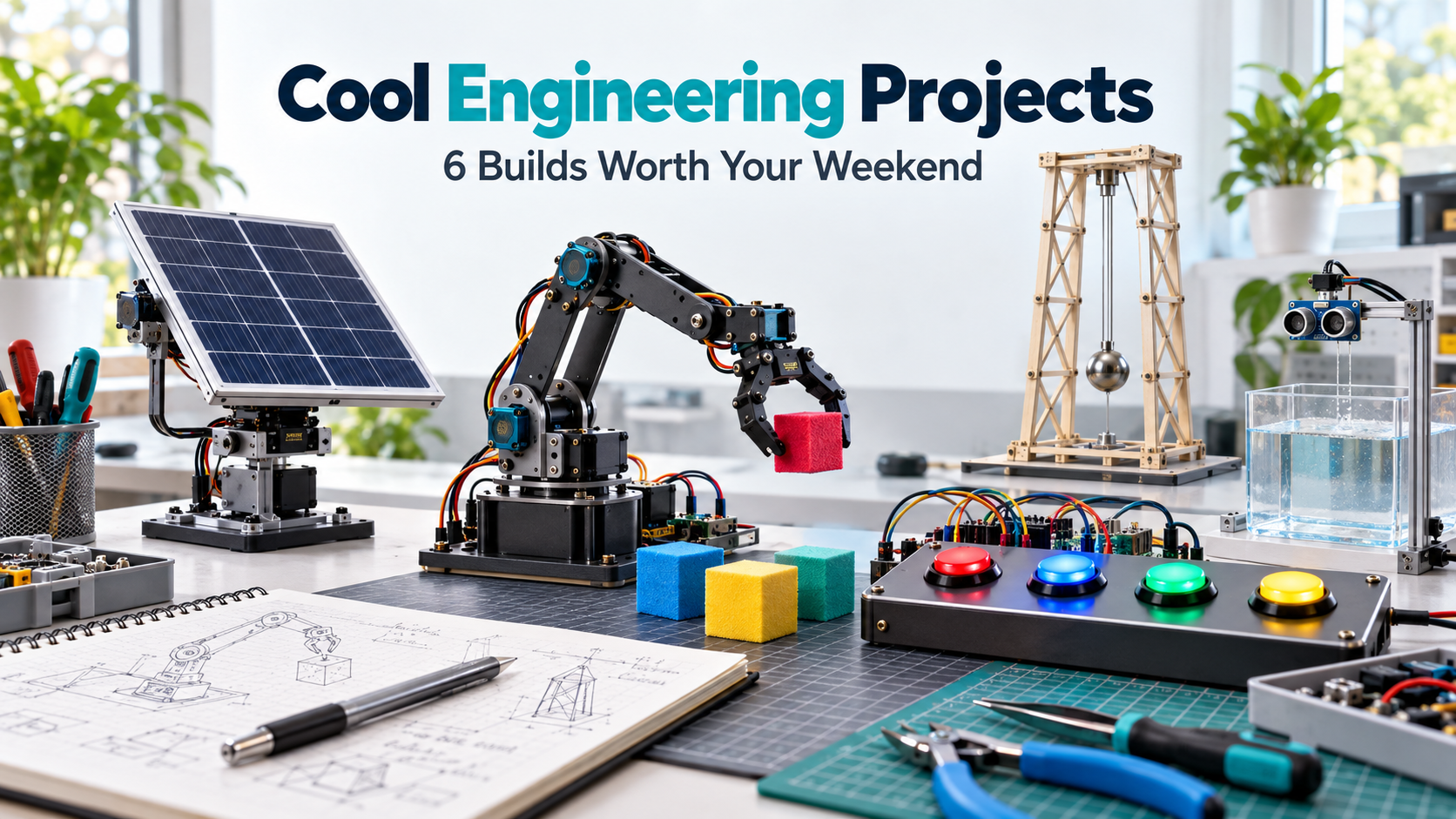
Cool engineering projects give you something satisfying to demonstrate and a problem worth solving. A small robot that places an object accurately, a solar tracker that earns its energy use, or a model tower that visibly resists vibration can do both.
You do not need a machine shop or an unlimited budget. You need a manageable first version, a way to measure performance, and enough curiosity to investigate what goes wrong.
The six ideas below suit young professionals who want hands-on experience outside their usual assignments. Think of a weekend as the starting point, not a guarantee that every prototype will reach completion by Sunday. Each option includes a test and an upgrade, so you can choose how far to take it.
Choose DIY Engineering Projects You Can Finish
Start with the result you want to demonstrate. “Move a foam cube between two marked locations” gives you a clearer target than “make a robot.”
Choose one unfamiliar element. If you are learning embedded programming, use a simple frame. If fabrication interests you, keep the electronics familiar. Tackling every new skill at once creates too many possible explanations when something stops working. Explore more practical engineering projects to turn your next weekend build into a tested prototype that demonstrates your technical skills.
Use this comparison to find a suitable starting point. Difficulty depends on your existing tools and experience; these labels describe the proposed scope.
| Prototype | Starting scope | Main challenge | Useful measurement |
| Tabletop arm | Intermediate | Coordinating motion and stiffness | Placement error |
| Room automation model | Beginner to intermediate | Reliable sensing and logic | Correct state changes |
| Reaction-time game | Beginner | Timing and input handling | Missed or false button events |
| Solar tracker | Intermediate | Measuring net benefit | Energy delivered minus tracking use |
| Level monitor | Beginner to intermediate | Consistent readings | Error against a ruler |
| Tower damper | Intermediate | Matching dynamic behavior | Peak motion and decay |
For broader planning advice, our Engineering Projects guide explains how to set requirements and document results.
Build a Robotic Arm That Places Objects Consistently
A robotic arm looks impressive, but repeatable motion makes it interesting. Start with a small mechanism that moves a lightweight object between two positions. Leave machine vision and elaborate grippers for later.
Use short links, a stable base, and actuators suited to the load. A longer reach increases the torque requirement at the joints. Flexibility and joint clearance also affect where the end point lands.
Begin by checking one unloaded joint. The official Servo Sweep example demonstrates commanding a servo through a sequence of positions. Confirm your hardware’s permitted travel before adapting it to a mechanism.
Test Repeatability Before Adding Features
Mark a target on paper and repeat the placement ten times. Measure the distance from each landing point to the target. Tight clustering away from the target suggests a different problem than widely scattered results.
Keep fingers clear of joints and provide an accessible way to disconnect the supply. Size that supply for the actuator demand; do not assume a controller board can provide it.
For an upgrade, smooth the movement between positions. Compare placement results before and after the change rather than judging only by appearance.
Prototype a Smart Home Automation System
Create a tabletop room model with a light sensor, a presence input, and a low-voltage LED. The goal: turn the light on when someone is present and the room is dark, then turn it off after a defined vacancy period.
Keep household wiring out of the prototype. You can learn the decision logic using a small lamp indicator without switching mains electricity.
Write down the expected response for each combination of inputs. Include startup and sensor disconnection. A system that behaves correctly only after you manually reset it has an unfinished requirement.
Prevent Annoying On-Off Cycling
If brightness hovers near the switching threshold, the output may chatter. Try different thresholds for switching on and off, or require a condition to persist briefly before changing state.
Check whether the LED itself influences the light sensor. Otherwise, your device could switch on, detect its own illumination, and switch off again.
Add a phone dashboard only after the local behavior works. Remote visibility is useful, but it cannot correct unreliable sensing. Record deliberate fault tests alongside successful demonstrations.
Use Arduino to Create a Reaction-Time Game
A reaction-time game combines a button, an indicator, and timing logic. It is fun to demonstrate, yet it exposes surprisingly useful software problems.
After a variable waiting period, illuminate the indicator and measure the delay until the player presses the button. Detect early presses so players cannot win by holding the button down.
Describe the sequence as separate states: waiting to start, waiting for the cue, timing the response, and displaying the result. This makes unexpected behavior easier to trace than a long chain of delays.
Check the Timer, Not Just the Player
Button contacts can bounce, creating several transitions from one press. Handle those transitions deliberately and check that you record one result per round.
Do not treat an entertaining score as a calibrated human-performance measurement. Input detection and display timing contribute their own uncertainty.
For an upgrade, store several rounds and show the median response. You can also generate a known delayed input to check the timing logic separately from human reactions. That distinction is useful whenever software measures a physical event.
Compare a Solar Tracker With a Fixed Panel
A small solar powered tracker asks a better question than “Can the panel follow the light?” Ask whether movement produces enough additional energy to justify the tracking mechanism.
Use a small panel, a stable adjustable mount, and an appropriate low-voltage measurement setup. Begin with manual angle changes before adding a motor. Record output into a suitable load, not just open-circuit voltage.
For a fair comparison, observe a similar fixed panel alongside the moving one under matched conditions. Passing clouds can otherwise masquerade as an improvement. Keep shading and mounting differences in your notes.
Measure the Net Result
Estimate energy over the trial from repeated power measurements and the time between them. Include the consumption of the tracking components when assessing the benefit.
You may find that frequent movement adds little under your test conditions. That result still tells you something useful. Try a wider movement threshold or less frequent adjustment.
Secure the mount against wind and keep the first version portable. Treat it as a benchtop experiment, not a rooftop installation. Reliable measurements matter more here than a dramatic moving assembly.
Make a Desktop Water-Level Monitor
A clear container, a ruler, and a compatible distance sensor give you a visible measurement problem. Mount the sensor above the water surface and compare its reported distance with a manual reference.
Check the selected sensor’s range, minimum distance, and suitability for the target surface. Not every device returns a dependable reading from a small container. Keep the electronics outside the splash area.
Take measurements at several levels. Include both filling and draining so you can spot inconsistent behavior. Convert the measured distance to level using a clearly defined reference point.
Separate a Valid Reading From a Missing One
Introduce a brief obstruction and observe the response. The software should identify an invalid reading instead of presenting it as an empty or overflowing container.
Add a high-level indicator as your first upgrade. Then test how surface movement affects it. Requiring several consistent readings can reduce nuisance indications, but introduces delay; measure that tradeoff.
Keep this demonstration separate from any real flood-protection duty. Its value lies in understanding measurement limits, not in assuming a prototype alarm will protect your home.
Test a Miniature Tower With a Tuned Damper
Build a small flexible tower from lightweight materials and attach a movable mass near its top. The aim is to compare vibration with and without a tuned damper.
Use a modest tabletop model with a secure base. Start with a small, repeatable sideways displacement, release it, and record the motion against a reference grid. Keep the camera position fixed.
A suspended mass can exchange energy with the tower, while damping dissipates it. Its effectiveness depends on tuning and the motion you excite. Simply hanging a weight does not guarantee improvement.
Compare More Than One Trial
Change the suspension length or mass gradually, then repeat the same release. Compare peak displacement and how quickly oscillations decrease. Do not combine a different starting displacement with a different damper and call the result a fair test.
This experiment connects mechanics and science in a way you can see. It also shows why understanding how things are made matters: loose joints or an inconsistent base can overwhelm the effect you hoped to study.
Turn Awesome Engineering Projects Into Portfolio Evidence
A short video attracts attention. Measurements explain why your prototype deserves it. Together, they show both initiative and technical judgment.
Use Engineering Principles to connect your demonstration to requirements, assumptions, and tradeoffs. Your portfolio does not need a breakthrough. It needs a clear account of a problem you investigated.
Include five items in the final entry:
- The intended outcome and the limits you set.
- A photograph, sketch, or wiring diagram.
- The reasoning behind one important choice.
- Measured results, including variation or failed trials.
- The next change you would test and why.
Keep credit accurate when you adapt tutorials or collaborate. Explain your contribution. A recruiter or technical reviewer can ask much better questions when you identify what you changed, tested, and learned.
For weekend projects, define a stopping point before you start buying parts. One dependable function with evidence beats an expanding collection of unfinished features.
Frequently Asked Questions
What Are Some Impressive Engineering Projects?
A precise tabletop robot, a tracker with a measured net benefit, and a working vibration damper all provide strong demonstrations. The impressive part is explaining why they perform as they do. Show repeatable results and the limits of your test setup.
Which Options Suit Beginners, Students, or Kids?
The reaction game and room model offer manageable starting points. Supervised versions can help students understand sensing and cause-and-effect without complex fabrication. Match tools, voltages, and moving components to the participant’s experience. Adults can use the same basic setup to investigate timing accuracy or fault handling more deeply.
What Are Some Creative Project Ideas?
Give a familiar device a specific constraint. Can the arm place a fragile object gently? Can the room model ignore brief shadows? Can the level monitor distinguish surface movement from a sustained change? A focused requirement often creates a more interesting challenge than adding another gadget.
Is a 3.7 GPA Bad for Engineering?
On a 4.0 scale, a 3.7 GPA is generally a strong academic result. Individual employers and graduate programs weigh it differently. Use hands-on experience to complement your transcript by showing that you can investigate uncertainty, explain choices, and finish a useful piece of work.
What Is the Coolest Type of Engineering?
That depends on what captures your attention. Robotics combines motion and code; structural experiments reveal forces; sensing turns physical conditions into data. Try a small example before deciding. The field that makes you curious about an unexpected result is a good place to keep exploring.