
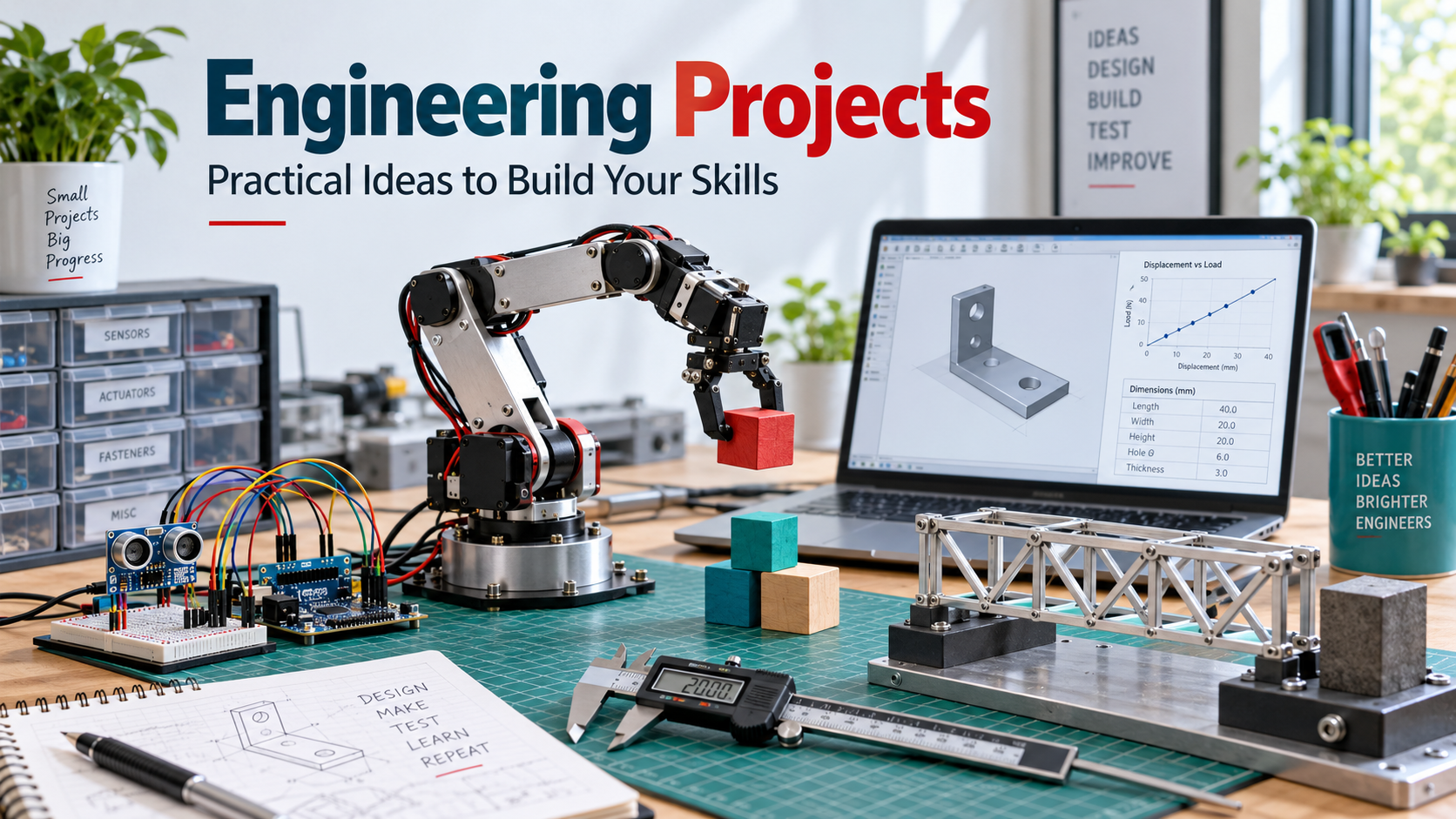
Engineering projects turn technical knowledge into something you can measure, test, and improve. The most useful ones start with a specific problem: reduce a bracket’s deflection, catch missing sensor readings, or shorten a repetitive task without introducing errors.
What should you work on first? How ambitious should it be? And will anyone care about a small weekend prototype when you apply for your next role?
Start with a problem you can finish investigating. A modest device with clear requirements and honest test results gives you plenty to discuss. An elaborate concept that never leaves your laptop gives you less.
Whether you recently graduated or already own part of a client deliverable, independent work gives you room to make decisions you might not yet make on the job. Choose an approach. Discover its limits. Explain what you would change.
What Makes the Work Worth Doing?
A worthwhile effort connects a need, a proposed solution, and evidence that the solution works. You should be able to explain all three without opening a slide deck.
Suppose you assemble a temperature sensor from a tutorial. You learn wiring and basic programming. Useful experience. Now give it a requirement: record readings every minute, flag a disconnected sensor, and preserve earlier records after a restart. Suddenly, you have decisions to make and failures to investigate.
That shift turns a demonstration into practical engineering. You move beyond following instructions and start taking responsibility for an outcome.
Use Engineering Principles to connect your choices to constraints, tradeoffs, and evidence. Cost matters. So do repeatability, ease of repair, and the time someone else needs to understand your work.
Choose an effort that teaches you something you cannot learn by watching another walkthrough. Perhaps that means testing an assumption, comparing two alternatives, or discovering why a calculation and a measurement disagree.
How to Choose an Engineering Project You Can Finish
Begin with your available time, workspace, and equipment. If you have a laptop and two evenings each week, a data checker fits better than a custom machine that needs welding and precision machining.
Write one sentence describing the outcome. For example: “Create a tool that finds duplicate timestamps and missing values in a sensor file, then produces a readable report.”
Next, decide what you will exclude. That tool does not need cloud hosting, user accounts, or a phone app. Those features can wait until the core task works.
Pick one unfamiliar element and keep the rest manageable. Learning a new programming language, circuit board layout, wireless networking, and enclosure fabrication at the same time creates several ways to stall.
For a young professional, the strongest starting point often comes from an everyday frustration. A spreadsheet takes too long to check. A fixture slips during repeated use. A measurement arrives without units. These small problems expose the same reasoning habits that larger assignments demand.
Before committing, confirm that you can access the inputs and test the result. Keep employer information and client data out of personal work unless you have permission.
Engineering Projects: Compare Six Starting Points
Use this list of options to match your interests with a measurable outcome. The scope assumes a small educational prototype, not equipment for service in the field.
| Starting point | Main question | Useful result to measure | First deliverable |
| Lightweight bracket | Can a geometry change reduce deflection without adding mass? | Deflection under the same load | Drawing and comparison chart |
| Temperature logger | Can the device collect dependable readings and identify faults? | Missing records and response to disconnection | Time-stamped file and fault log |
| Small beam comparison | How does section orientation affect stiffness? | Midspan deflection | Predicted and measured curves |
| Data quality checker | Can software find known problems consistently? | Correct detections and false alarms | Tested script and sample report |
| Repetitive task improvement | Can a revised method save time without increasing errors? | Cycle time and error count | Before-and-after study |
| Insulated container comparison | Which configuration slows cooling under matched conditions? | Temperature change over time | Test procedure and cooling curves |
You do not need to attempt every option. Choose one that lets you complete a full cycle of prediction, testing, and revision.
Mechanical Project Ideas: Test a Lightweight Bracket
Small mechanical projects work well when you can change one feature and measure the effect. A benchtop bracket is a good example because stiffness, geometry, and connection details all influence the result.
Set a modest target: support a small known load while keeping tip deflection below a limit you choose. Keep the fixture close to the bench and the loading arrangement contained. Do not use the prototype to support people or valuable equipment.
Sketch two configurations with the same mounting arrangement. Compare a flat profile with a ribbed or deeper section. Predict which will deflect less before testing either one.
Record dimensions, mass, load position, and mounting details. If you use printed parts, keep print orientation and settings consistent so they do not confuse the comparison.
Understanding how things are made matters here. A geometry that looks efficient on screen may require awkward supports, leave weak connections, or make assembly difficult.
The most interesting result may come from the fixture. If the mounting surface flexes, your measurement includes that movement too. Explain the limitation and improve the setup before declaring one version better.
For a useful extension, compare stiffness per unit mass. You may find that a slightly heavier part performs much better, or that removing material from the wrong location saves little weight while causing substantial movement.
An Electrical Project: Track Temperature and Detect Faults
A low-voltage temperature logger combines electronics, programming, and troubleshooting without requiring an elaborate setup. Use a compatible development board, a sensor, and a suitable low-voltage supply. Keep the work away from mains wiring.
Define the recording interval, expected temperature range, and response to a missing reading before you build the prototype. Decide whether the system should retry, record a fault, or stop collecting data.
Then test more than its normal behavior. Disconnect the sensor. Restart the board. Interrupt the connection to the receiving computer. Check whether the records distinguish a valid zero from missing information.
Many electronics projects produce convincing displays while hiding unreliable inputs. Compare readings with a reference instrument whose limitations you understand. Agreement at room temperature alone does not establish accuracy across the full range.
Keep this version focused on observation. Adding automatic heater control introduces further failure modes and changes the scope considerably.
A useful final demonstration shows a normal recording period, an intentional fault, and recovery. Include a simple wiring diagram and instructions that let someone repeat the test without guessing which pin connects where.
Extend the work only after that sequence behaves consistently. An enclosure, battery supply, or remote dashboard can become a separate iteration with its own requirements.
Compare Small Beams and Their Deflection
For a civil or structural starting point, compare small beams on a tabletop fixture. Use light loads and a contained setup that keeps hands clear if a specimen slips or breaks.
Begin with two specimens of the same cross section, or rotate one rectangular specimen between tests. Predict how orientation will affect stiffness. Keep the span, support arrangement, and loading position unchanged.
Measure deflection at several load increments within the specimen’s elastic range. Unload it and check whether it returns close to its starting position. Permanent deformation means your simple elastic comparison no longer describes the entire response.
These design projects teach a useful distinction: stiffness describes resistance to deformation; strength concerns resistance to failure. A specimen can deflect too much for its intended use before it breaks.
Choose materials you can measure consistently, and record defects or dimensional differences. Wood grain, uneven supports, and measurement resolution can all affect your observations.
Treat the exercise as a model. Do not turn a successful tabletop test into a claim about a full-size structure. The value lies in explaining the relationship between your prediction, setup, and results.
Create a Data Quality Checker
If you prefer software, create a script that checks a small sensor dataset. Start with synthetic records so you know exactly which problems the file contains.
Include a duplicate timestamp, a missing value, an unexpected unit label, and a reading outside a declared range. Specify what each rule means. An unusual value might deserve review without automatically qualifying as an error.
Separate file reading, validation, and reporting so you can test each part independently. Software Engineering Principles help you keep those responsibilities clear as the tool grows.
Measure both correct detections and false alarms. A program that flags every row technically catches every bad row, but it creates useless work for the person reviewing the report.
Preserve the original file. Produce a separate results file that identifies the row, the rule, and the reason for each flag. Handle empty files and malformed records deliberately instead of letting the program fail without explanation.
For an extension, accept a configuration file with different limits. That change tests whether your solution can adapt without scattering hard-coded values throughout the source.
Improve a Repetitive Workflow
Some of the best opportunities require no new hardware. Examine a repeatable task such as preparing sample labels, organizing parts, or checking a report for missing fields.
Observe the current method before proposing changes. Record several cycles and note interruptions, errors, and rework. Separate active task time from waiting time so you understand what actually causes the delay.
Try one adjustment: rearrange the workspace, introduce a template, or change the sequence of steps. Repeat the observations under comparable conditions.
Suppose an illustrative trial reduces median completion time from ten minutes to eight. That represents a 20 percent reduction for the measured task. It does not establish a 20 percent improvement across the whole department, especially if the revised method adds work elsewhere.
Check quality alongside speed. A faster labeling process that creates more identification mistakes fails the real requirement.
Document whether practice influenced the results. If someone repeats the task many times, familiarity alone may improve performance. Compare methods fairly and state the limits of a small trial.
Follow a Repeatable Development Process
The engineering design process becomes easier to use when you attach a concrete output to each stage. Avoid treating it as paperwork you complete after the interesting part.
- Define the problem and who experiences it. Write a short statement describing the need.
- Set measurable requirements. Include operating conditions, cost limits, and acceptance criteria.
- Compare alternatives. Explain why you chose one approach and rejected another.
- Create the smallest useful prototype. Resolve the biggest uncertainty before adding features.
- Test against the requirements. Record the setup, observations, and unexpected behavior.
- Revise and document. Repeat the relevant tests after making changes.
A requirement such as “easy to use” leaves too much room for interpretation. “A new user can generate the report using the written instructions without assistance” gives you something observable, though you still need to define a suitable trial.
Set a stopping point too. Finish when you can demonstrate the agreed outcome, describe the limitations, and reproduce the result. Extra features should earn their place by solving a real problem.
That boundary matters when you work around a full-time job. A finished, narrow investigation gives you a foundation for the next version. An expanding feature backlog rarely gives you the same satisfaction.
Test the Assumptions Most Likely to Fail
Before testing, ask which assumption could invalidate your conclusion. Perhaps the sensor updates more slowly than you expect. Perhaps the supports move. Perhaps your timing method includes several seconds of inconsistent setup.
Start there.
Repeat measurements and retain the raw records. If results vary, investigate the spread instead of selecting the cleanest run for your chart. Record changes to the setup so you can distinguish a real improvement from a different test condition.
Think about resolution. A ruler cannot support a claim of movement far smaller than its graduations. Similarly, a displayed temperature with several decimal places does not automatically have that accuracy.
Include at least one relevant fault condition. A loose connection, unexpected input, or interrupted run can reveal whether your solution fails clearly or quietly produces misleading results.
For a fair comparison, change one main variable when possible. If you change geometry, loading, and measurement location together, you will struggle to explain which change caused the difference.
Good science habits help: make a prediction, describe the method, preserve observations, and revise your explanation when the evidence disagrees.
Turn Your Results Into a Portfolio
Your portfolio should show how you think, not just what the finished object looks like. Give each entry a short problem statement, a photograph or screenshot, and one clear result.
Explain the constraint that shaped your decision. Limited workspace? Inconsistent input files? A strict mass target? Then describe the alternative you considered and why you chose your approach.
Include a result that changed your mind. Perhaps a thicker bracket offered little benefit because the connection dominated movement. Perhaps a validation rule caught bad records but generated too many false alarms. Those details reveal judgment.
Keep claims proportional to the evidence. Say you reduced errors in your test dataset, not that you created a universally reliable system. Identify your own contribution clearly when others helped.
Make the work reproducible with a concise readme, drawings, source files, or a test procedure. Remove confidential information before sharing anything publicly.
An interviewer should be able to understand the problem in a minute and ask deeper questions about your decisions. Give them enough evidence to have that conversation.
Frequently Asked Questions
What Is Considered an Engineering Project?
It is a focused effort that uses technical analysis, constraints, and testing to solve a problem. The output might be a physical prototype, a calculation tool, or an improved process. What matters is the connection between the need, your decisions, and measurable evidence.
What Are Good Options for Beginners and Students?
Start with a small beam comparison, a temperature logger, or a file-checking script. Simple engineering projects for students can help students understand concepts more deeply when they predict results before testing. For high school STEM activities, match tools and supervision to the participants and keep loads and voltages low.
What Should Adults With Full-Time Jobs Choose?
Choose something you can pause and restart without lengthy setup. Software checks, small fixtures, and measurement studies often fit that constraint. Break the work into a first working version and one improvement. Leave optional features for later.
Do I Need Expensive Equipment?
No. A laptop-based investigation can provide substantial learning without fabrication equipment. Physical experiments need instruments suited to the question, but greater expense does not guarantee a better investigation. Narrow the question until your available tools can answer it honestly.
What Are Some Major Projects in the Field?
Bridges, water treatment facilities, power networks, and spacecraft are large-scale examples. You can explore a small part of their underlying problems through a benchtop study or simulation. Keep the boundary clear: an educational model does not establish readiness for real-world service.
How Do I Know When I Have Done Enough?
You can explain the need, demonstrate the result, and name the remaining limitations. Another person can follow your documentation and understand the evidence. At that point, publish the work, capture the next question, and decide whether another iteration deserves your time.