
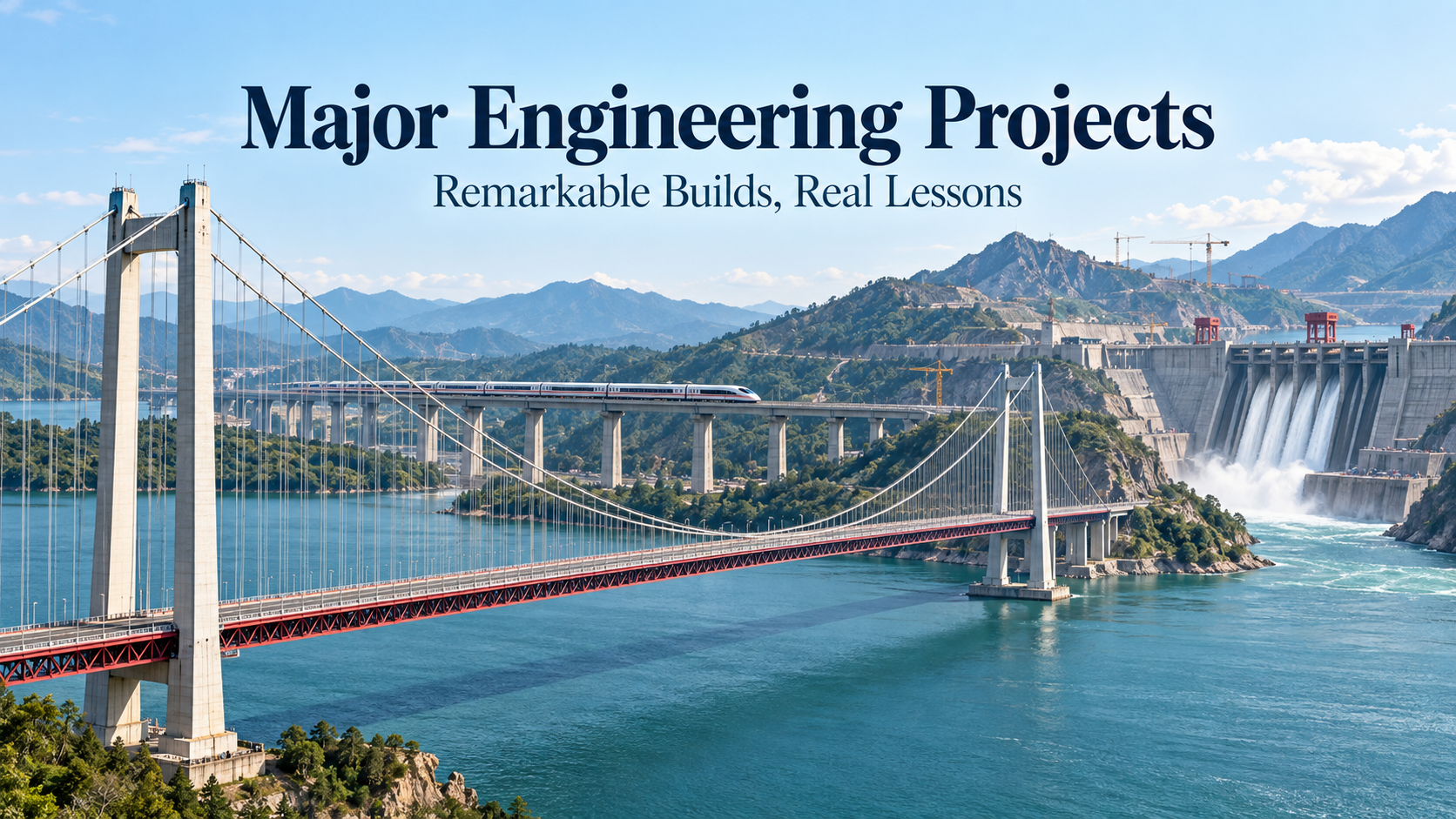
A tunnel beneath the sea. A river crossing that serves generations. An orbiting laboratory assembled through international cooperation. These achievements show what happens when thousands of technical decisions come together successfully.
For a young engineer, the interesting questions start beyond the photographs. How did the team handle uncertainty? What had to happen before the next stage could begin? How does anyone inspect or replace a component after opening day?
The examples below offer different answers. Some demonstrate long service lives; others reveal the demands of integration or the uncertainty of ambitious development. Study the decisions behind them, and you will find lessons that apply to your next calculation, equipment selection, or site visit.
Practice the problem-solving habits behind these remarkable builds with hands-on engineering projects that let you compare alternatives, test assumptions, and measure results.
What Makes a Project Major?
Size matters, but complexity often matters more. A development can demand exceptional coordination because it crosses borders, introduces unfamiliar technology, or connects many systems that must function together.
A billion-dollar budget does not tell you whether the owner faces difficult ground conditions or an unusually demanding operating environment. Likewise, a smaller installation can carry enormous consequences if its failure interrupts drinking water service or hospital operations.
Compare projects using a consistent basis. Are you measuring total expenditure, physical dimensions, technical difficulty, or the number of people who depend on the result? Those measures produce different rankings.
The largest construction projects also tend to contain smaller packages with different schedules and owners. Excavation may finish while equipment manufacturing continues elsewhere. One delayed component can prevent several otherwise completed packages from entering service.
Use this comparison as a guide to what each example can teach you. The lessons represent engineering interpretations, not claims that these projects faced identical problems.
| Example or project category | Main issue to study | Question for your own assignment |
| Historic river crossing | Inspection, rehabilitation, changing use | Can someone maintain what I specify? |
| Undersea transport link | Emergency access and equipment integration | What happens when normal operation stops? |
| Passenger rail network | Interfaces and commissioning | Do the separate packages function together? |
| Aviation hub | Passenger movement and operating continuity | Where does congestion move after this change? |
| Orbital laboratory | Compatibility and remote maintenance | How will teams verify connections before assembly? |
| Large urban development | Phasing and uncertain demand | Does each stage provide a usable outcome? |
Brooklyn Bridge: Think Beyond Opening Day
The Brooklyn Bridge connects Manhattan and Brooklyn across the East River. Construction began in 1869 and finished in 1883; its main span measures 1,595.5 feet. New York City’s transportation department also documents later strengthening, roadway alterations, and rehabilitation. These changes make its service history as instructive as its original achievement. See the NYC DOT history and project overview.
The lesson is lifecycle thinking. An asset does not stop demanding engineering attention when the owner opens it. Traffic patterns change. Components deteriorate. Inspection findings create new priorities.
For your own work, imagine the maintenance crew arriving decades after the original team has moved on. Can they reach the component? Can they identify its material and connection details? Can they replace it without dismantling everything nearby?
Those questions influence drawings now. A small access provision can determine whether a future repair takes hours or requires a lengthy shutdown.
Follow the Load and the Repair Sequence
When studying a crossing like this, trace how loads travel through the structure to the ground. Then consider what happens during repairs. Removing or unloading one element changes the conditions that adjacent elements experience.
That is a useful habit even when your assignment involves a modest equipment platform. Ask how the contractor will support the assembly during installation and how the owner will maintain it later.
Historic examples also remind you to distinguish original features from later modifications. A present-day photograph may show the result of many interventions. Read the asset history before attributing every detail to the original designer.
Channel Tunnel: Plan for Access and Failure
The Channel Tunnel links Britain and France through two rail tunnels and a central service tunnel. Getlink describes cross-passages at 375-meter intervals and explains the central route’s role in maintenance and emergency evacuation. The arrangement shows how access can shape an entire layout. See Getlink’s explanation of the tunnel system.
The engineering challenge extends well beyond creating an opening through the ground. Trains, drainage, ventilation, communications, and emergency procedures must operate as a coordinated whole.
Here is the practical takeaway: define abnormal conditions while you still have room to change the layout. A service route cannot become an afterthought once every available space contains equipment.
Ask What Happens After Something Stops
Consider a hypothetical pump installation. The normal operating calculation confirms the required duty. Now ask how staff will isolate the pump, remove it, and restore service. If the answer requires blocking an emergency route or removing unrelated equipment, the layout needs attention.
The same reasoning scales to a long tunnel. Access, isolation, and recovery deserve their own requirements and verification activities.
Young engineers can contribute by checking these details early. Trace an access path on the drawing. Confirm removal clearances. Ask which equipment remains available during an outage.
You may not own the entire system, but you can identify an assumption that nobody has resolved. That is valuable work, particularly when several disciplines each believe another team owns the answer.
High-Speed Rail and Railway Construction: Make the Parts Agree
A high-speed rail project combines track geometry, vehicles, signaling, electrical supply, stations, and operating rules. Each package can meet its individual specification while the combined service still needs substantial testing.
Railway construction therefore offers a useful lesson in interfaces: the points where separate responsibilities meet. A vehicle must fit the route’s clearances. A platform must suit the train. Information must pass correctly between onboard and trackside equipment.
Do not confuse the completion of physical work with readiness to carry passengers. A finished installation still needs verification under the conditions in which people will use it.
Treat Integration as Its Own Deliverable
For an everyday parallel, imagine two contractors supplying a tank and its level instrument. Both items pass factory inspection. During installation, the team discovers that the connection geometry does not match.
Neither inspection answered the combined question: will these items fit and function together?
Good interface management assigns someone to resolve that question before shipment. It records dimensions, signals, responsibilities, and acceptance criteria. It also controls changes so one supplier does not quietly invalidate another supplier’s assumptions.
When reviewing a rail scheme, look for this same discipline across organizational boundaries. Ask how the team verifies compatibility, who accepts the evidence, and what happens when a requirement changes.
This is also why Engineering Management Principles matter to technical staff. Clear ownership and coordinated decisions affect whether sound calculations become a functioning service.
International Airport Projects: Design Around Movement
An international airport brings passengers, baggage, aircraft, staff, and service vehicles through interconnected spaces. Expanding one part changes demands elsewhere. More gates, for example, can place additional pressure on baggage handling, security queues, and ground transportation.
This category illustrates a common infrastructure problem: local improvements do not automatically improve the whole operation.
Suppose a hypothetical terminal expansion doubles the number of check-in positions. If downstream screening capacity remains unchanged, the queue may simply move. The owner needs a throughput assessment that follows passengers through the complete journey.
The same reasoning applies to a factory line or treatment process. Increasing one unit’s capacity helps only when the adjacent units can accept the additional demand.
Keep Existing Operations in the Plan
Construction at an operating facility introduces another constraint. Crews need access, but users still need a functioning service. Temporary routes, shutdown windows, and commissioning sequences become part of the technical solution.
A drawing that depicts only the final arrangement may leave the hardest question unanswered: how do we get there?
Develop stage-by-stage views. Identify temporary connections and verify their capacity. Show when the team can remove them. Bring operators into the review before the sequence becomes difficult to change.
For early-career professionals, this is a good reason to attend coordination meetings and site walks. You can see how a building’s physical layout interacts with staffing, movement, and maintenance. Those observations often explain requirements that look arbitrary at your desk.
An Orbiting Laboratory: Coordinate Across Boundaries
The International Space Station (ISS) provides a different scale of coordination. NASA identifies five contributing space agencies and documents continuous human occupancy since November 2000. Its assembly and upkeep involve modules, visiting vehicles, and maintenance activities in orbit. See NASA’s station facts and figures.
The useful lesson is compatibility under difficult access conditions. Teams cannot rely on an ordinary site visit to correct every mismatch after delivery.
That makes interfaces, verification, and configuration records particularly interesting to study. What connection does a component need? Which version of the drawing governs fabrication? How will someone detect a fault and replace the affected item?
Practice Traceability on Small Assignments
You can develop these habits without joining a space program. Give each important requirement a clear test or review method. Record the revision of the item you evaluate. Keep the result connected to that revision.
If someone changes a component afterward, decide which checks need repetition. A successful test of the previous version does not automatically validate the revised one.
This approach can feel formal when you first encounter it. Its purpose becomes clear when a teammate asks, “Which configuration actually passed?” You should not have to reconstruct the answer from scattered email attachments.
Treat documentation as part of the usable product. The next person needs enough information to operate, troubleshoot, or modify the assembly without guessing what the original team intended.
NEOM: Separate the Vision From Verified Delivery
NEOM provides an opportunity to examine how engineers should read ambitious development proposals. In its current description of THE LINE, the developer emphasizes a phased, demand-led approach within a long-term urban vision. That description states an approach and ambition; it does not establish that the complete vision already exists. See the official description of THE LINE.
When evaluating a proposal, separate announced scope, funded scope, work underway, and operating assets. These categories answer different questions. A compelling rendering offers little evidence about commissioning or long-term performance.
Be equally careful with sustainability claims. Ask what the team measures, where the assessment starts and ends, and which assumptions drive the result. Building materials, operating demand, transport patterns, and replacement cycles can all affect the comparison.
Make Each Phase Useful
For a hypothetical new district, ask whether the first occupied buildings can function before later phases arrive. Residents need water, transport, maintenance access, and reliable services from the beginning.
An early phase that depends entirely on an uncertain future phase creates a delivery problem. Test those dependencies explicitly.
The same principle applies to expanding an industrial site. Can the initial installation operate independently? Will temporary provisions become permanent if funding changes? What triggers the next investment?
These questions do not dismiss ambition. They translate it into decisions that owners can review. Your role is to identify which assumptions need evidence and which dependencies need a workable alternative.
What to Bring Into Your Own Practice
You do not need a famous assignment to use these lessons. Start with the package on your desk and look beyond its immediate calculation.
Ask who receives your output and what they need to do with it. A procurement team needs clear requirements. An installer needs dimensions and tolerances. An operator needs access and understandable instructions. A reviewer needs your assumptions and supporting evidence.
Then examine the transitions. Many difficulties appear when one team hands responsibility to another: from analysis to detailing, fabrication to installation, or testing to operation.
Building information modeling, or BIM, can help teams coordinate spatial information, but a shared model does not settle every responsibility. Someone must still decide which information governs and resolve discrepancies.
Develop the habit of asking one more question before closing a review comment. “It fits” might lead to “Can someone remove it?” “It runs” might lead to “How will we know when performance deteriorates?”
That extra question often produces more value than another polished presentation. Use Engineering Principles to keep those questions connected to requirements, evidence, and practical limits.
Compare Estimates Without Misleading Yourself
A headline budget can conceal different boundaries. One estimate may include land acquisition, financing, and supporting utilities; another may describe only the main contract. Currency, price year, and inflation assumptions also matter.
Before comparing two figures, check what each includes. Apply the same care to schedules. An opening date, completion of physical work, and final acceptance may represent different milestones.
This habit transfers directly to equipment evaluations. A lower purchase price may accompany higher maintenance needs or a more difficult installation. Compare the full scope relevant to the decision, then state what remains uncertain.
Look for Evidence After Handover
Opening day establishes only part of the outcome. Look for operating availability, maintenance demands, and whether the asset delivers the intended service. These measures help you distinguish successful delivery from successful long-term use.
For facilities such as power plants, treatment works, or oil terminals, an attractive arrangement still needs practical access and dependable operating procedures. The environmental consequences of normal operation and foreseeable failures also deserve attention.
As a junior team member, you can ask for feedback from completed assignments. Did operators encounter the problems the team predicted? Which detail caused repeated maintenance trouble? Carry those observations into your next review. Experience becomes useful when you connect it to a specific decision.
Frequently Asked Questions
What Are the Top 10 Engineering Projects in the World?
There is no universal ranking. A historical selection might include the Panama Canal, Hoover Dam, Golden Gate Bridge, the Pyramids of Giza, the Apollo program, Burj Khalifa, Japan’s Shinkansen, Brooklyn Bridge, the Channel Tunnel, and the ISS. Treat that as a varied study collection, not a measured league table.
What Are the Top 10 Mega Projects in the World?
The answer depends on whether you count announced developments, active programs, or completed assets. Define the category and comparison date first. Rankings based on projected expenditure can change as owners revise scope, funding, or delivery plans. Avoid comparing a multi-decade regional program directly with a single construction contract.
What Are Some Good Projects for a Young Engineer?
Choose a manageable problem with a measurable result: compare two support arrangements, develop a sensor logger, or automate a data check. Our guide to Engineering Projects explains how to define requirements and document results. Practice the same habits that larger programs demand: clear assumptions, controlled changes, and evidence that the finished result meets its purpose.