
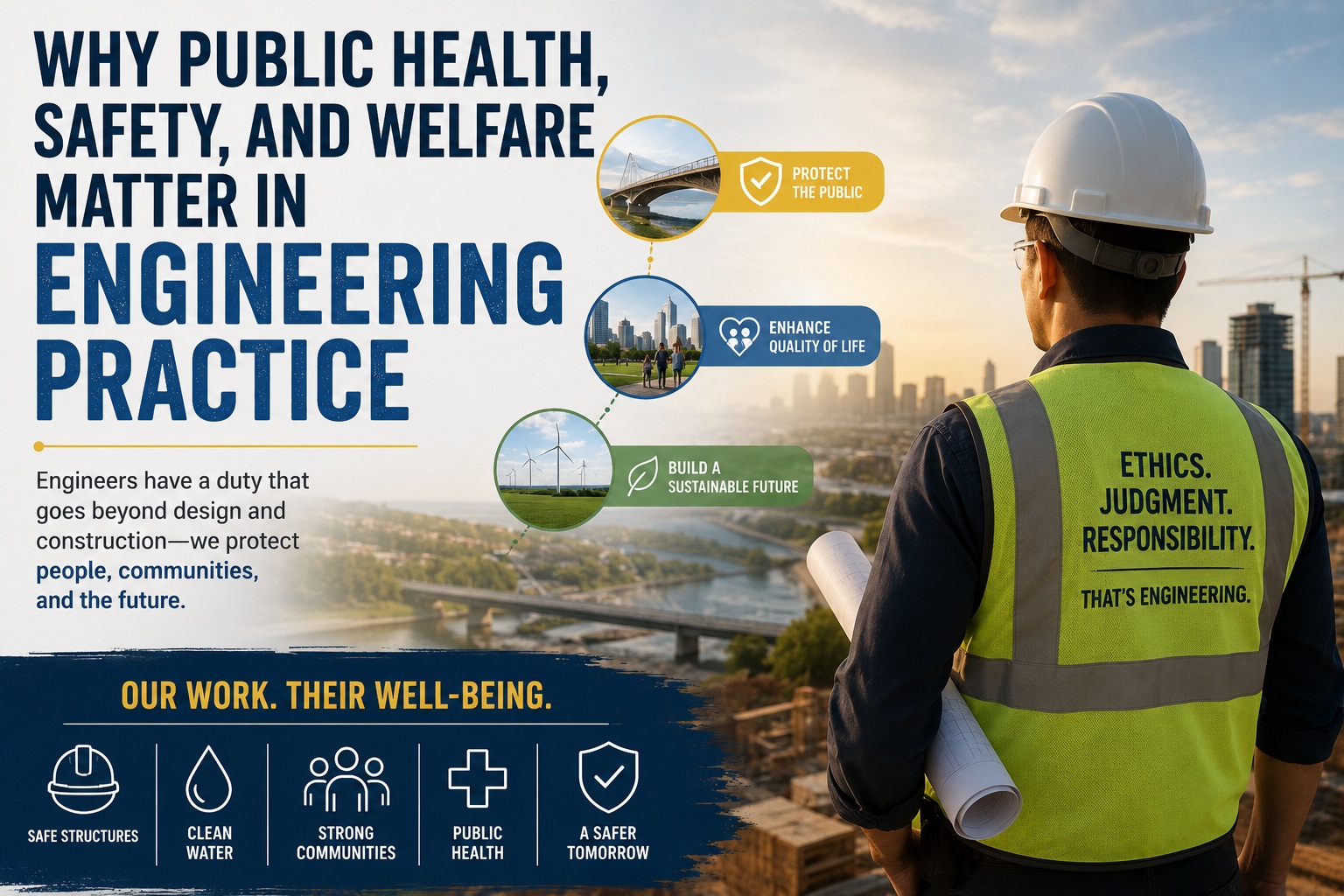
Engineering is a profession built on public trust. When engineers design systems, evaluate risks, review plans, prepare reports, inspect facilities, or recommend technical solutions, their decisions can affect people far beyond the immediate project team.
A bridge must carry traffic safely. A drinking water system must protect public health. A building must resist expected loads. A manufacturing process must control hazards. An electrical system must operate safely. A remediation system must protect people and the environment. A software-controlled system must perform reliably when safety is at stake.
Because engineering work can affect lives, property, infrastructure, and the environment, professional engineers have a duty to place public health, safety, and welfare at the center of their practice.
This principle is one of the foundations of engineering ethics. It is not just language found in professional codes of conduct. It is a practical obligation that affects everyday engineering decisions.
Engineering Decisions Affect People
Engineering is often technical, but its consequences are human.
The public may not see the calculations, models, design assumptions, specifications, inspections, sampling plans, operating limits, or quality reviews that support an engineering decision. But the public lives with the results.
People drive on roads and bridges. They work in buildings. They rely on drinking water systems, wastewater systems, electrical grids, mechanical systems, medical devices, industrial facilities, transportation networks, and environmental protections. They assume that qualified professionals have considered safety, reliability, compliance, and foreseeable risks.
That assumption creates responsibility.
An engineer’s work may affect:
- Occupants of a building
- Workers in a facility
- Drivers and pedestrians
- Residents near a project site
- Users of a product or system
- Construction crews
- Maintenance personnel
- Utility customers
- Communities affected by environmental decisions
- Future users who may inherit the facility, structure, or system
Engineers may work for a client or employer, but their decisions can affect a much broader group of people.
Public Health, Safety, and Welfare Are Connected
The phrase “public health, safety, and welfare” is often used as a single concept, but each part has meaning.
Public health involves protecting people from conditions that may cause illness, exposure, contamination, or other health risks. This may involve drinking water, wastewater, air emissions, hazardous materials, indoor air quality, sanitation, environmental contamination, chemical exposure, and other issues that affect human health.
Public safety involves reducing the risk of injury, death, structural failure, fire, electrical hazards, mechanical hazards, transportation accidents, process failures, and other dangerous conditions.
Public welfare is broader. It includes the well-being of communities, the reliability of infrastructure, environmental protection, access to essential services, resilience, sustainability, and the long-term consequences of engineering decisions.
These three ideas overlap. A design failure can create safety risks. A treatment failure can create health risks. Poor infrastructure decisions can affect community welfare. Environmental problems can affect health, safety, property, and quality of life.
Engineering practice often requires engineers to consider all three together.
The Public May Not Be in the Room
One reason public protection matters is that the public is often not directly represented in project decisions.
Clients, owners, developers, agencies, contractors, manufacturers, and employers may all have important roles in a project. They may also have understandable concerns about cost, schedule, constructability, operations, or business objectives.
But the people who may be affected by the work are often not present when technical decisions are made.
Residents near a site may not know the details of a remediation plan. Building occupants may not understand structural or mechanical design assumptions. Drivers may not know how transportation safety decisions were made. Workers may not know whether a process hazard was evaluated correctly. The public relies on engineers and other professionals to identify and address risks before problems occur.
This is why engineers must not view public protection as someone else’s concern. It is part of the engineer’s professional role.
Engineering Ethics Requires More Than Serving the Client
Engineers often work for clients or employers, and those relationships are important. Engineers should provide competent service, communicate clearly, meet contractual obligations, and help clients solve problems.
However, professional responsibility is not limited to client service.
An engineer’s duty to the public may require difficult conversations. A client may prefer a lower-cost option. An employer may want a faster schedule. A contractor may request approval of a substitution. A project team may want to avoid delay. Those pressures are common in engineering practice.
The ethical issue arises when cost, schedule, convenience, or business interests conflict with public health, safety, or welfare.
An engineer may need to say:
- This design approach creates unacceptable risk.
- Additional investigation is needed before a recommendation can be made.
- The proposed change should be reviewed before approval.
- The data do not support that conclusion.
- This work is outside my area of competence.
- This issue should be disclosed to the client, regulator, owner, or public agency.
- I cannot sign and seal this document without proper review.
These statements may be uncomfortable, but they are sometimes necessary.
Codes and Standards Help Protect the Public
Codes, standards, regulations, and accepted engineering practices exist in large part to protect public health, safety, and welfare.
Building codes, electrical codes, fire codes, environmental regulations, design standards, pressure vessel standards, transportation criteria, water quality regulations, process safety requirements, and other technical rules provide a framework for responsible practice.
However, codes and standards do not replace engineering judgment.
A code may establish a minimum requirement, but the engineer must still determine whether that requirement applies to the specific situation. A standard may provide a method, but the engineer must understand its assumptions and limitations. A regulation may set a compliance threshold, but the engineer must evaluate whether the data are reliable and representative.
In some cases, meeting the minimum requirement may not be enough to address a known risk. In other cases, a project may involve unusual conditions that require additional evaluation.
Public protection requires both compliance and judgment.
Public Safety Is Not Limited to Structural Engineering
When people think about engineering safety, they often think about bridges, buildings, dams, and other visible infrastructure. Those are important examples, but public safety applies to every engineering discipline.
Civil engineers affect public safety through transportation systems, drainage, site development, utilities, construction, flood control, and public infrastructure.
Structural engineers affect public safety through buildings, bridges, foundations, towers, retaining structures, inspections, and repair designs.
Mechanical engineers affect public safety through HVAC systems, pressure systems, fire protection coordination, ventilation, equipment design, and mechanical reliability.
Electrical engineers affect public safety through power distribution, grounding, arc flash protection, emergency systems, lighting, controls, and communication systems.
Environmental engineers affect public health and safety through drinking water, wastewater, remediation, air quality, hazardous waste, exposure control, and regulatory compliance.
Chemical engineers affect safety through process design, reaction control, material handling, emissions control, pressure systems, and hazardous operations.
Industrial engineers affect worker safety, process reliability, ergonomics, quality systems, and operational risk.
Software, computer, and systems engineers may affect safety when digital systems control equipment, vehicles, utilities, medical devices, infrastructure, or critical data.
The specific hazards differ by discipline, but the ethical obligation is the same.
Public Health Requires Careful Technical Judgment
Public health issues can be complex because they often involve exposure, uncertainty, long-term effects, and regulatory interpretation.
Engineers may need to evaluate water quality data, air emissions, treatment system performance, contaminant migration, ventilation rates, chemical handling, waste management, or environmental monitoring results. These decisions may affect whether people are exposed to contaminants, unsafe conditions, or preventable health risks.
Public health protection requires engineers to be careful with data and assumptions.
For example, an engineer should consider whether sampling results are representative, whether a treatment system is performing as intended, whether exposure pathways have been evaluated, whether uncertainty has been communicated, and whether recommendations are supported by the available information.
An engineer should not minimize a potential health concern simply because it is inconvenient, expensive, or uncertain. Uncertainty should be addressed through appropriate investigation, conservative assumptions, monitoring, or clear communication.
Public Welfare Includes Long-Term Consequences
Public welfare is sometimes harder to define than health or safety, but it is an important part of engineering practice.
Engineering decisions can affect the long-term well-being of communities. Infrastructure reliability, environmental quality, energy use, resilience, accessibility, sustainability, and maintainability all influence public welfare.
A project may be technically functional but still create long-term problems if it is poorly maintained, inefficient, difficult to operate, vulnerable to foreseeable hazards, or harmful to the surrounding community.
Engineers should consider questions such as:
- Will this system be reliable over its intended life?
- Can it be maintained safely?
- Does the design account for foreseeable operating conditions?
- Are environmental impacts being managed responsibly?
- Are future users or operators being considered?
- Does the project create avoidable risks for the community?
- Have limitations been clearly communicated?
Public welfare requires engineers to think beyond the immediate design or short-term project objective.
Professional Competence Protects the Public
Competence is central to public protection.
Engineers should only perform work they are qualified to do by education, experience, or appropriate supervision. Practicing outside one’s competence can create serious risks, even when the engineer has good intentions.
Engineering projects often involve multiple disciplines. A civil engineer may need structural input. A mechanical engineer may need electrical coordination. An environmental engineer may need hydrogeologic or toxicological expertise. A software engineer working on safety-critical controls may need input from mechanical, electrical, process, or safety professionals.
Public protection requires engineers to recognize the limits of their knowledge.
An ethical engineer knows when to ask for help, obtain a specialist review, recommend additional investigation, or decline work that is outside the engineer’s competence.
Communication Is Part of Public Protection
Clear communication is one of the most important ways engineers protect the public.
Engineering work is often used by people who were not involved in the original analysis. Reports, drawings, specifications, calculations, permit applications, inspection notes, and operating procedures must communicate important information accurately.
Poor communication can create risk.
A report that hides uncertainty can mislead a client or regulator. A drawing that omits a critical note can lead to construction errors. A specification that is unclear can result in improper materials. An inspection report that downplays a serious condition can delay corrective action. An email that gives a quick answer without necessary qualifications can be misunderstood.
Engineers should communicate in a way that is accurate, clear, and appropriate for the audience.
This includes identifying assumptions, limitations, risks, recommended actions, and conditions that require further review.
Documentation Supports Accountability
Documentation is part of ethical engineering practice because it creates a record of decisions, assumptions, findings, and recommendations.
Good documentation helps show what information was considered, what judgment was applied, and why a decision was made. It also helps future engineers, owners, operators, regulators, and reviewers understand the basis for the work.
Important items to document may include:
- Design assumptions
- Calculations
- Field observations
- Data limitations
- Code interpretations
- Deviations from plans
- Client decisions
- Engineering recommendations
- Safety concerns
- Review comments
- Changes in conditions
- Basis for professional opinions
Documentation is especially important when public health, safety, or welfare could be affected. If a concern is significant enough to influence a decision, it may be significant enough to document.
Engineers Must Respond to Known Risks
Engineers may encounter situations where a risk becomes apparent during design, construction, inspection, operation, or review.
The ethical response depends on the situation, but ignoring a known risk is rarely acceptable.
An engineer may need to investigate further, notify a supervisor, inform the client, recommend corrective action, document the issue, stop work, involve another qualified professional, or notify an authority if required by law or professional obligation.
Examples of known risks may include:
- A structural deficiency
- Unsafe field conditions
- Inadequate treatment performance
- Unreliable safety controls
- Noncompliant equipment
- Contaminant exposure concerns
- Fire protection concerns
- Electrical hazards
- Incomplete or misleading data
- Construction that differs from approved plans
- A design assumption that is no longer valid
Professional judgment is required, but the engineer’s responsibility to public protection should guide the response.
Cost and Schedule Do Not Eliminate Responsibility
Engineering projects must consider cost and schedule. A solution that cannot be built, operated, maintained, or funded may not be practical.
However, cost and schedule cannot be used to justify unsafe or irresponsible engineering decisions.
Engineers may need to find alternatives, phase work, recommend interim controls, explain risk, or help clients make informed decisions. Practical constraints should be addressed honestly, not used to hide or ignore professional concerns.
When cost or schedule pressure conflicts with public protection, engineers should document the issue and communicate it clearly. The engineer’s role is not to make every project more expensive or conservative than necessary. The role is to make sure decisions are technically sound, ethically responsible, and protective of the public.
Public Trust Depends on Engineering Integrity
Most people cannot independently verify whether engineering work is safe or technically sound. They rely on engineers to act with integrity.
That trust is earned through competent work, honest communication, careful review, ethical conduct, and willingness to raise concerns when needed.
When engineers fail to protect public health, safety, and welfare, the consequences can be severe. Failures can cause injury, loss of life, environmental damage, financial loss, regulatory enforcement, public distrust, and damage to the reputation of the profession.
Even when no failure occurs, careless or misleading engineering practice can weaken public confidence.
Engineering integrity is not only about avoiding misconduct. It is about consistently making decisions that respect the responsibility engineers carry.
Public Protection in Everyday Practice
Public health, safety, and welfare are not limited to major disasters or high-profile projects. They are part of everyday engineering practice.
They appear when an engineer checks a calculation carefully.
They appear when an engineer refuses to sign work that has not been reviewed.
They appear when an engineer communicates a limitation clearly.
They appear when an engineer recommends additional testing.
They appear when an engineer documents a field concern.
They appear when an engineer asks for input from another discipline.
They appear when an engineer explains risk to a client.
They appear when an engineer chooses a design approach that is safer and more reliable.
These routine decisions may never attract public attention, but they help prevent problems.
Continuing Education Supports Public Protection
Continuing education helps engineers maintain the knowledge and judgment needed to protect the public.
Codes change. Standards evolve. Regulations are updated. Technology advances. New risks emerge. Engineers who stop learning may rely on outdated assumptions or practices.
Continuing education can support public protection by helping engineers stay current with:
- Technical standards
- Codes and regulations
- Ethics requirements
- Professional practice expectations
- Safety principles
- Environmental requirements
- Emerging technologies
- Risk management
- Lessons learned from failures
- Documentation and communication practices
For licensed professional engineers, continuing education is not only a renewal requirement. It is part of maintaining competence and fulfilling professional responsibility.
Questions Engineers Should Ask
When making decisions that may affect public health, safety, or welfare, engineers can ask:
- Who could be affected by this decision?
- What are the consequences if this assumption is wrong?
- Is the work within my competence?
- Have applicable codes and standards been considered?
- Are there unusual conditions that require additional review?
- Have risks and limitations been communicated clearly?
- Is more information needed before making a recommendation?
- Have concerns been documented?
- Could cost or schedule pressure be affecting judgment?
- Would another qualified engineer understand and support the decision?
- Would I be comfortable explaining this decision to a state board or the public?
These questions help engineers connect technical decisions to professional responsibility.
Bottom Line
Public health, safety, and welfare matter in engineering practice because engineering decisions affect people. The public relies on engineers to apply technical knowledge with competence, honesty, care, and sound judgment.
This responsibility applies to every engineering discipline. Whether the work involves structures, systems, processes, infrastructure, equipment, environmental protection, software, utilities, or public facilities, engineers must consider how their decisions affect others.
Protecting the public is not a slogan. It is the ethical foundation of engineering practice.
For professional engineers, that means practicing within one’s competence, communicating clearly, following applicable codes and standards, documenting important decisions, responding to known risks, and placing public protection above improper pressure.
Engineering work matters because people depend on it. That is why public health, safety, and welfare must remain at the center of professional engineering practice.