
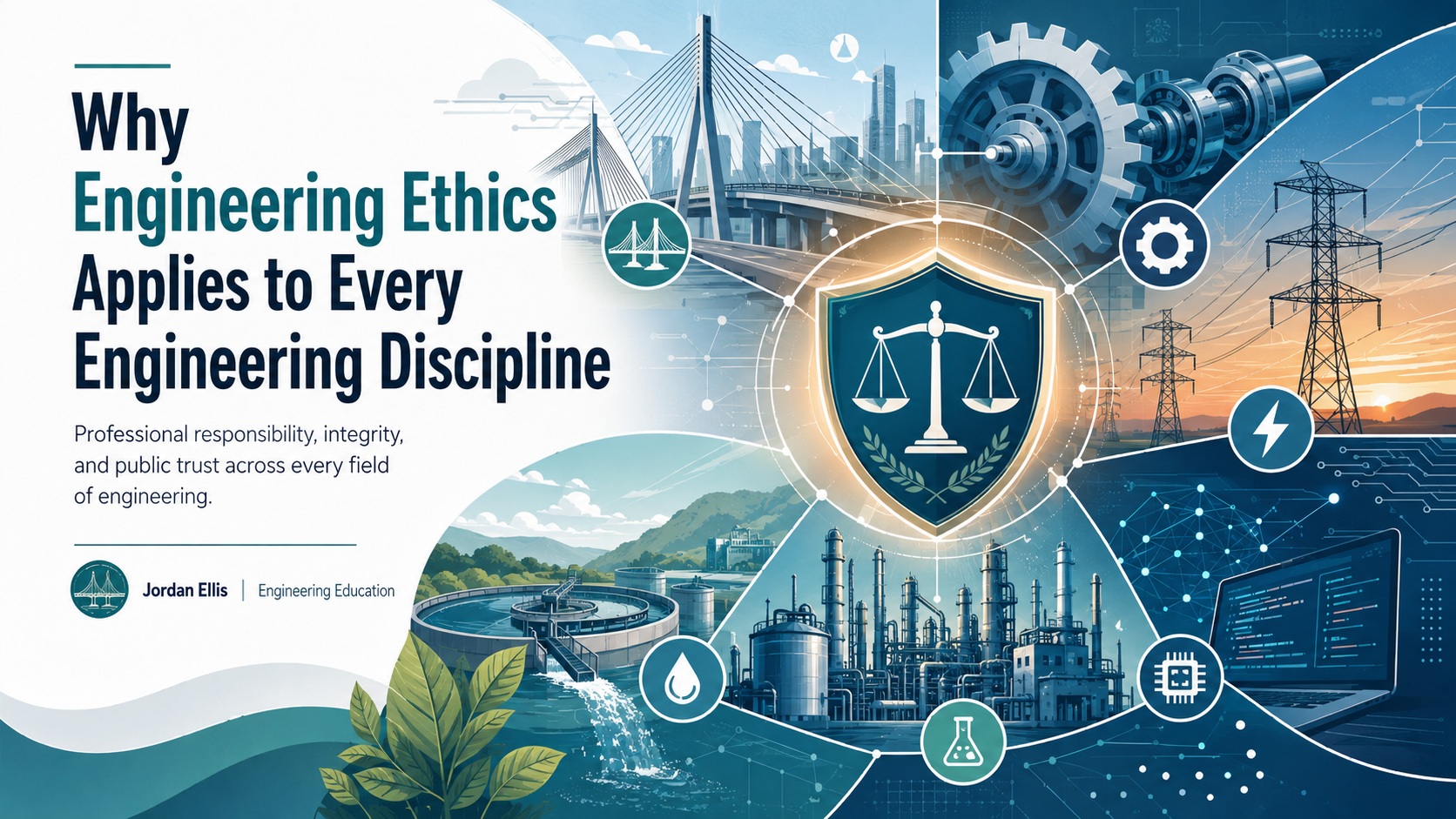
Engineering ethics is sometimes discussed as if it mainly applies to civil engineers, structural engineers, environmental engineers, or other professionals whose work is visibly connected to public infrastructure. That view is too narrow.
Ethics applies to every engineering discipline because every engineering decision involves responsibility. Whether an engineer designs a bridge, specifies a pressure vessel, develops control software, evaluates emissions, designs a medical device, reviews electrical systems, or manages a manufacturing process, the work can affect people, property, the environment, public confidence, and the integrity of the profession.
The details may vary by discipline, but the ethical foundation is the same. Engineers are expected to use their knowledge responsibly, practice within their areas of competence, communicate honestly, protect public health and safety, and recognize when technical decisions create broader consequences.
That is why engineering ethics is not a separate subject reserved for a few practice areas. It is part of professional engineering itself.
Engineering Ethics Is Based on Professional Responsibility
Engineering is a technical profession, but it is also a public trust profession. Engineers are granted authority because society relies on their technical judgment. Clients, employers, regulators, contractors, manufacturers, and the public often depend on engineers to identify risks, apply standards, and make recommendations that non-engineers may not be qualified to evaluate on their own.
That trust creates responsibility.
Professional engineers are not expected to be perfect, but they are expected to act with honesty, competence, care, and sound judgment. Engineering ethics provides the framework for those expectations. It helps engineers answer practical questions such as:
- Am I qualified to perform or approve this work?
- Have I communicated the risks clearly?
- Have I allowed schedule, budget, or business pressure to affect my judgment?
- Have I protected confidential information appropriately?
- Have I disclosed conflicts of interest?
- Have I considered the effect of this decision on public health, safety, and welfare?
- Have I documented assumptions, limitations, and recommendations accurately?
These questions can arise in any engineering discipline.
Ethics Is Not Limited to Public Infrastructure
Civil and structural engineering are often used as examples in ethics discussions because the connection to public safety is easy to see. Bridges, buildings, roads, dams, stormwater systems, and public utilities have direct and visible consequences when engineering fails.
But other engineering disciplines also affect the public, even when the connection is less obvious.
A mechanical engineer may design HVAC systems that affect indoor air quality, energy use, fire protection, or occupant safety. An electrical engineer may design power distribution systems, grounding systems, automation controls, or life-safety systems. A chemical engineer may evaluate process safety, hazardous materials, emissions, or production systems. An environmental engineer may make recommendations affecting drinking water, groundwater, air quality, waste management, or regulatory compliance. A software or computer engineer may develop systems used in transportation, manufacturing, health care, energy, finance, or critical infrastructure.
In each case, engineering judgment can affect real people.
The fact that the public may not see the engineer’s work does not make the ethical responsibility smaller. In many fields, the most important engineering decisions occur behind the scenes, long before a product, facility, system, or process reaches the public.
Every Discipline Involves Competence
One of the most important ethical obligations in engineering is competence. Engineers should undertake assignments only when they are qualified by education, experience, or appropriate supervision.
This applies across all disciplines.
A civil engineer should not approve a complex electrical design without appropriate expertise. A mechanical engineer should not represent expertise in geotechnical design without the necessary qualifications. A chemical engineer should not make structural recommendations outside his or her competence. An engineer working in software, automation, or data systems should recognize when the system affects safety-critical operations and when additional expertise is needed.
Competence is not only about degrees or job titles. It is about whether the engineer has the knowledge and experience needed for the specific task.
Engineering work often becomes multidisciplinary. A manufacturing project may involve mechanical systems, electrical controls, environmental permitting, chemical processes, safety systems, and structural supports. A remediation project may involve hydrogeology, treatment system design, instrumentation, construction, permitting, and health and safety. A building project may involve civil, structural, mechanical, electrical, plumbing, fire protection, and energy systems.
In multidisciplinary work, ethical practice requires engineers to understand the limits of their own expertise and rely on qualified professionals when needed.
Ethics Applies to Design Decisions
Design is not just a technical exercise. It involves judgment, assumptions, tradeoffs, and responsibility.
Engineers routinely make design decisions involving safety factors, materials, operating conditions, load assumptions, environmental conditions, reliability, maintainability, cost, schedule, and compliance. These decisions may appear technical, but they often have ethical dimensions.
For example:
- Should a design assumption be clearly stated because it affects performance?
- Should a less expensive option be rejected because it creates unacceptable risk?
- Should a client be warned that a requested shortcut may violate good practice?
- Should a calculation be checked by another qualified person?
- Should a design be revised because field conditions differ from the original assumptions?
- Should an engineer refuse to approve work that does not meet applicable standards?
These questions are not limited to one discipline. They arise wherever engineers design systems, products, structures, processes, equipment, software, or facilities.
Good engineering design requires technical skill. Ethical engineering design requires technical skill combined with honesty, judgment, and responsibility.
Ethics Applies to Communication
Engineering communication is an ethical issue because unclear or incomplete communication can lead to poor decisions.
Engineers communicate through reports, drawings, specifications, calculations, emails, presentations, field notes, inspection forms, permit applications, design memoranda, and professional recommendations. These documents are often used by clients, contractors, regulators, operators, other engineers, and the public.
An engineer has an ethical responsibility to communicate accurately and clearly.
This includes:
- Identifying assumptions and limitations
- Avoiding misleading statements
- Distinguishing facts from opinions
- Explaining uncertainty where it matters
- Reporting results honestly
- Documenting changes and deviations
- Providing recommendations that are technically supportable
- Making sure important risks are not hidden or minimized
A report that omits a significant limitation can be misleading. A drawing that does not clearly show a critical detail can create construction risk. A recommendation that overstates certainty can cause a client to make an uninformed decision. A failure to document a known concern can create problems later.
Clear communication is part of ethical practice in every engineering discipline.
Ethics Applies to Public Health, Safety, and Welfare
The protection of public health, safety, and welfare is central to engineering ethics. This principle is often discussed in connection with licensed professional engineers, but the underlying responsibility applies broadly across engineering practice.
Different disciplines protect the public in different ways.
Civil and structural engineers protect the public through safe infrastructure, buildings, foundations, transportation systems, and water management systems.
Mechanical engineers protect the public through safe equipment, HVAC systems, pressure systems, fire protection interfaces, energy systems, and machinery.
Electrical engineers protect the public through safe power systems, controls, grounding, communications, lighting, instrumentation, and life-safety systems.
Environmental engineers protect the public through water treatment, wastewater management, remediation, air quality control, waste management, and environmental compliance.
Chemical engineers protect the public through process safety, material handling, reaction control, emissions control, and safe manufacturing systems.
Industrial engineers protect the public and workforce through systems design, safety, ergonomics, productivity, quality, and process improvement.
Software, computer, and systems engineers may protect the public through cybersecurity, automation, data integrity, safety-critical controls, transportation systems, medical technology, and infrastructure monitoring.
The specific risks are different, but the ethical duty is consistent. Engineers must consider how their work affects people.
Ethics Applies to Business Pressure
Engineering work does not happen in a vacuum. Engineers operate within businesses, agencies, consulting firms, manufacturing companies, utilities, institutions, and project teams. These environments include budgets, deadlines, contracts, client expectations, management goals, and competitive pressures.
Those pressures are real. They are also where many ethical issues arise.
An engineer may be asked to finish a review too quickly, reduce testing, approve incomplete work, minimize a concern, reuse an old design without adequate review, accept uncertain data, overlook a code issue, or avoid documenting a problem because it could delay a project.
These situations can occur in any discipline.
Ethics helps engineers respond when professional judgment conflicts with outside pressure. The ethical engineer does not ignore cost or schedule, but also does not allow cost or schedule to override safety, compliance, competence, or honesty.
A practical ethical response may involve documenting concerns, explaining risks, proposing alternatives, requesting additional review, elevating the issue within the organization, or declining to approve work that is not technically acceptable.
Ethics Applies to Emerging Technologies
Engineering practice is changing rapidly. New tools, materials, digital systems, artificial intelligence, automation, sensors, modeling platforms, and data-driven methods are being used across many engineering disciplines.
These developments create new opportunities, but they also create ethical questions.
For example:
- Can an engineer rely on a software output without understanding its assumptions?
- How should engineers validate AI-assisted design or analysis?
- Who is responsible when automated systems affect safety-critical operations?
- How should engineers protect sensitive technical data?
- What level of human review is needed for digital tools?
- How should uncertainty in models be communicated?
- Are new materials or systems being used before their limitations are understood?
These questions affect more than one discipline. They are relevant to structural modeling, environmental data analysis, process control, transportation systems, energy systems, manufacturing, software development, and many other areas.
As technology changes, engineering ethics becomes more important, not less. Engineers must understand the tools they use, recognize their limitations, and remain responsible for professional judgment.
Ethics Applies to Engineers Who Are Not in Traditional Design Roles
Not every engineer spends the day preparing calculations or drawings. Many engineers work in management, operations, technical sales, permitting, quality control, research, construction oversight, product development, safety, compliance, maintenance, education, or consulting.
Ethics still applies.
An engineer in operations may make decisions affecting safety, reliability, environmental compliance, and maintenance priorities. An engineer in management may decide whether a project has adequate technical review. An engineer in product development may evaluate testing, quality, labeling, or known limitations. An engineer in technical sales may need to avoid overstating product performance. An engineer in education or content development must present technical information accurately. An engineer in regulatory compliance must report information honestly and completely.
Engineering ethics follows the professional wherever technical judgment is being used.
Ethics Applies to Professional Reputation
Engineers are part of a profession that depends on public confidence. When engineers act with integrity, they strengthen that confidence. When engineers ignore ethical obligations, the damage can extend beyond a single project or employer.
Unethical conduct can lead to unsafe conditions, regulatory violations, financial loss, environmental harm, professional discipline, damaged client relationships, and loss of public trust.
Even smaller issues matter. Inaccurate reports, poor documentation, undisclosed conflicts, careless review, exaggerated claims, and failure to communicate risks can erode confidence in an engineer’s work.
Professional reputation is built over time through consistent conduct. Engineers demonstrate ethics not only in major decisions, but also in routine work habits.
Ethics Is a Daily Practice
Engineering ethics is sometimes taught through dramatic examples of failure, misconduct, or disaster. Those examples are important, but they can make ethics seem like something that only appears in extreme situations.
In reality, ethics is often part of ordinary professional practice.
It appears when an engineer checks a calculation carefully instead of assuming it is correct. It appears when an engineer asks for review on a topic outside his or her expertise. It appears when an engineer tells a client that a preferred option has limitations. It appears when an engineer documents uncertainty in a report. It appears when an engineer refuses to sign work that has not been properly reviewed. It appears when an engineer corrects a mistake rather than hiding it.
These decisions may not attract attention, but they are the foundation of ethical engineering practice.
Why Ethics Education Matters for Every Engineer
Continuing education in engineering ethics helps engineers recognize professional responsibilities before problems arise. It also reinforces the judgment needed to handle difficult situations.
Ethics education is valuable because it helps engineers:
- Understand professional obligations
- Recognize conflicts of interest
- Communicate risk more clearly
- Maintain competence
- Understand the importance of public welfare
- Respond to pressure appropriately
- Improve documentation and decision-making
- Think through real-world professional scenarios
- Stay current with licensing expectations
For licensed professional engineers, ethics education may also be required for license renewal in many jurisdictions. But the value of ethics education goes beyond satisfying a PDH requirement. It helps engineers connect technical work with professional responsibility.
Discipline-Specific Knowledge Still Matters
Saying that ethics applies to every discipline does not mean every discipline faces the same risks. Engineering ethics must be applied within the context of actual practice.
A structural engineer may face ethical questions involving load paths, design assumptions, inspection findings, or construction deviations. A chemical engineer may face questions involving process hazards, operating limits, or material compatibility. An environmental engineer may face questions involving data interpretation, contaminant migration, or regulatory reporting. An electrical engineer may face questions involving arc flash hazards, system reliability, or safety controls. A software engineer may face questions involving data integrity, cybersecurity, or safety-critical algorithms.
The ethical principles are broad, but the application is specific.
That is why engineers need both technical continuing education and ethics continuing education. Technical education helps engineers maintain discipline-specific competence. Ethics education helps engineers apply that competence responsibly.
Bottom Line
Engineering ethics applies to every engineering discipline because every engineering discipline involves trust, judgment, competence, communication, and responsibility.
The public may see a bridge, building, treatment system, product, machine, electrical system, software platform, or manufacturing process. Behind each of those outcomes are engineering decisions. Those decisions affect safety, reliability, compliance, cost, environmental performance, and public confidence.
Ethics is not an optional topic and it is not limited to one branch of engineering. It is part of what makes engineering a profession.
For professional engineers, ethical practice means using technical knowledge responsibly, recognizing the limits of one’s expertise, communicating honestly, protecting public health and safety, and making decisions that uphold the integrity of the profession.
No matter the discipline, engineering ethics matters because engineering work matters.